
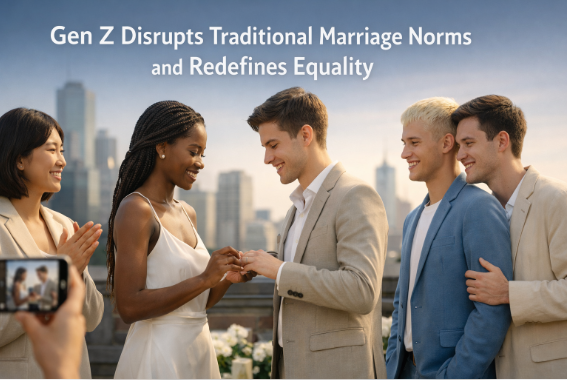
Gen Z Disrupts Traditional Marriage Norms and Redefines Equality
For generations, marriage was treated as a fixed destination. There was a familiar script: find the right person, settle down by a socially approved age, divide responsibilities in predictable ways, buy a home, have children, and build a life that looked recognizable to everyone around you. For many people, that script offered stability. But for Gen Z, marriage is no longer something to inherit without question. It is something to examine, reshape, and, in many cases, rebuild from the ground up.
This is what makes Gen Z one of the most fascinating generations to watch. They are not rejecting love. They are not walking away from commitment. They are challenging the assumptions that have surrounded marriage for decades. Instead of accepting traditional marriage norms as universal truth, they are asking harder questions. Why should gender decide who leads and who follows? Why should emotional labor fall on one partner? Why should financial dependence be romanticized? Why should marriage be measured by appearance rather than partnership? These questions are not signs of cynicism. They are signs of a generation trying to make relationships healthier, more honest, and more equal.
At the heart of this cultural shift is a deep desire for fairness. Gen Z has grown up in an era shaped by conversations about mental health, feminism, identity, economic pressure, and social justice. These issues do not disappear when love enters the picture. If anything, they become more important. For Gen Z, equality in marriage is not a bonus feature. It is a core expectation. They want relationships where both people are seen, heard, respected, and supported. That means traditional roles are being reexamined in real time.
One of the biggest ways Gen Z is redefining marriage is through the rejection of rigid gender roles. Older models of marriage often divided life into masculine and feminine responsibilities. Men were expected to provide financially. Women were expected to manage the home, maintain emotional harmony, and often sacrifice career growth for family needs. While many couples found ways to adapt within that structure, the structure itself remained powerful. Gen Z is far less willing to accept those defaults. They are more likely to see cooking, earning, parenting, cleaning, planning, comforting, and decision-making as shared responsibilities rather than gender-based duties.
This change may sound simple, but it is deeply transformative. When roles are assigned automatically, inequality can hide behind tradition. When roles are negotiated intentionally, both partners have more room to be themselves. A husband does not have to prove masculinity by dominating the relationship. A wife does not have to prove devotion by carrying invisible burdens. Instead, both people can define what partnership means for them. That flexibility is one of the clearest signs that Gen Z is changing modern marriage.
Another major shift is how Gen Z talks about emotional labor. Previous generations often normalized emotional imbalance in relationships. One partner, usually the woman, was expected to remember birthdays, manage family dynamics, soothe conflicts, plan social calendars, anticipate needs, and maintain the emotional temperature of the household. Much of this work went unnamed, even though it required time, energy, and mental focus. Gen Z is far more likely to recognize emotional labor as real labor. In their view, equality in marriage includes not just who pays the bills or changes the diapers, but who notices, who remembers, who initiates difficult conversations, and who carries the invisible work of keeping the relationship functioning.
That awareness matters because it changes how commitment is practiced. Equality is no longer limited to symbolic gestures or public declarations. It appears in everyday behavior. It shows up in who apologizes, who communicates clearly, who checks in, who makes room for vulnerability, and who takes responsibility for growth. Gen Z is bringing this level of emotional intelligence into dating and long-term partnership, and it is reshaping what a healthy marriage looks like.
Money is another area where Gen Z is disrupting traditional expectations. Financial pressure has changed the entire context of marriage. Rising housing costs, student debt, unstable job markets, and the increasing cost of living have forced young adults to think more practically about relationships. The old fantasy that marriage automatically guarantees financial security is no longer convincing. Gen Z knows that love does not cancel out economic reality. Because of that, they are often more open about finances before marriage, more cautious about legal and financial commitments, and more determined to build partnerships rooted in transparency.
This financial realism is not unromantic. In many ways, it is the opposite. Honest conversations about money can protect trust, reduce resentment, and build long-term stability. Gen Z couples are more likely to discuss who earns what, how bills will be split, what financial goals matter, and how economic power can affect decision-making. In traditional marriage models, the breadwinner often had more authority. Gen Z is challenging that imbalance by insisting that contribution should be measured in more than one way and that financial openness is essential to marital equality.
The age timeline around marriage is changing too. Gen Z does not feel the same urgency to marry early simply because society expects it. Many are prioritizing education, career development, healing, self-discovery, or financial independence before entering marriage. This delay is often misunderstood as fear of commitment, but that interpretation misses the point. For Gen Z, waiting can be an act of seriousness. It reflects a belief that marriage should happen when both people are ready to build something meaningful, not when they are pressured by social milestones.
This slower approach also reflects a broader change in values. Marriage is no longer the automatic marker of adulthood it once was. Gen Z is more likely to believe that being complete as an individual should come before merging lives with someone else. That does not mean they reject partnership. It means they want marriage to add to a full life rather than define their worth. In this way, self-respect and relationship respect are becoming more connected.
Gen Z is also more inclusive in how they define love, partnership, and family. Traditional marriage norms often centered a narrow image of what a couple should look like and how a family should function. Gen Z is far more likely to affirm diverse identities, different relationship structures, and nontraditional life paths. They are helping expand the public imagination around what commitment can be. Equality in marriage, from this perspective, is not just about fairness between two individuals. It is also about removing outdated social rules that excluded people based on gender, sexuality, culture, or lifestyle.
This inclusivity matters because it changes the language of commitment itself. Instead of treating one model as the gold standard, Gen Z is opening space for authenticity. Marriage is being redefined as a relationship built on consent, shared values, communication, mutual care, and freedom of expression. That redefinition can be deeply healing for people who never saw themselves represented in traditional marital ideals.
Technology has played a complex role in all of this. Gen Z has grown up online, exposed to countless examples of relationships, both healthy and harmful. Social media has made it easier to challenge old norms, learn from others, and normalize conversations about boundaries, therapy, communication, and emotional well-being. At the same time, digital culture can create pressure to perform the perfect relationship. Gen Z seems increasingly aware of that tension. Many are pushing back against performative romance and focusing instead on what happens behind closed doors: emotional safety, shared respect, and sustainable connection.
This emphasis on authenticity may be one of Gen Z’s strongest contributions to the future of marriage. They are less impressed by appearances alone. A beautiful wedding, a polished couple image, or a traditional household setup is not enough. They want substance. They want the relationship itself to be equitable, not just the optics around it. That mindset is forcing a cultural correction. Marriage is no longer judged only by whether it looks stable. It is judged by whether it feels fair.
Of course, this shift is not without tension. Traditional expectations do not disappear overnight. Many Gen Z individuals still face pressure from family, religion, culture, or community to follow established marriage patterns. Some want to honor tradition while also demanding equality. Others feel caught between modern values and inherited beliefs. That conflict can be painful, especially when love becomes a site of negotiation between personal freedom and collective expectation.
Yet even in that tension, Gen Z is doing something powerful. They are proving that tradition does not have to be obeyed blindly to be respected. It can be questioned, adapted, and transformed. Marriage can remain meaningful without remaining unchanged. In fact, one could argue that the institution survives best when it evolves with the people living inside it.
The conversation around parenting further reveals how Gen Z is redefining marriage. Younger couples increasingly expect childcare, household duties, and life planning to be shared. They are less likely to assume that one parent should automatically become the default caregiver while the other focuses on career advancement. This does not mean every couple will divide every task perfectly. Real life is more complicated than that. But the principle is clear: fairness matters, and care work deserves recognition. Marriage equality is not theoretical when children enter the picture. It becomes visible in sleep deprivation, scheduling, compromise, and responsibility.
Another important element is mental health. Gen Z has helped normalize therapy, emotional vocabulary, boundary-setting, and self-reflection in ways that directly influence marriage. Instead of seeing struggle as something to hide, many are willing to talk openly about trauma, attachment, stress, burnout, and communication challenges. This emotional honesty can strengthen relationships by reducing shame and encouraging repair. Traditional marriage norms often rewarded endurance at the expense of emotional truth. Gen Z is more likely to believe that healthy marriages require both commitment and emotional accountability.
This is especially important when discussing conflict. In older models, power often determined whose voice mattered more. Gen Z is more likely to prioritize communication tools that allow both partners to speak honestly and safely. They value listening, mutual problem-solving, and emotional regulation. They are not perfect at these things, but the aspiration itself marks a significant change. Equality in marriage is no longer just a legal or economic issue. It is relational. It lives in the daily practice of how two people treat each other when things are difficult.
Critics sometimes argue that Gen Z’s standards are too high or too idealistic. They claim that by questioning everything, young people are making marriage more complicated than it needs to be. But that criticism overlooks a crucial reality: many old marriage models were only simple on the surface. Beneath that simplicity were silence, sacrifice, imbalance, and unmet needs that often went unspoken. Gen Z is not making marriage harder for the sake of it. They are making its invisible complexities visible. And that honesty could ultimately create stronger, more resilient partnerships.
What emerges from all of this is not the death of marriage, but its renovation. Gen Z is not destroying the institution. They are stripping away assumptions that no longer serve modern relationships. They are asking marriage to become more humane, more equal, and more reflective of the lives people actually live today. They are moving it away from hierarchy and toward collaboration. Away from obligation and toward intention. Away from performance and toward authenticity.
That shift may be uncomfortable for those who equate tradition with stability. But stability built on inequality is fragile. A more durable future may come from relationships where both people feel valued and empowered. Gen Z understands this. They are not looking for a perfect formula. They are looking for partnership that feels real, respectful, and sustainable. They are building marriages where love is not confused with control, sacrifice is not demanded unequally, and equality is not postponed until later.
In many ways, Gen Z is offering a more mature vision of commitment than the stereotypes suggest. Their version of marriage is less about following a script and more about writing one together. It honors individuality without abandoning togetherness. It embraces intimacy without requiring conformity. It sees equality not as a threat to romance, but as the foundation that allows romance to survive real life.
The future of marriage will likely be shaped by this generation’s insistence on honesty, fairness, and flexibility. As Gen Z continues to challenge outdated expectations, they are redefining what it means to love someone well. And perhaps that is the most hopeful disruption of all. Not the rejection of marriage, but the refusal to settle for a version of it that leaves one partner smaller, quieter, or less free. In its place, Gen Z is creating something stronger: a model of modern marriage built on mutual respect, emotional transparency, shared responsibility, and genuine equality.
SEO paragraph: Gen Z and marriage trends are reshaping the future of modern relationships, with growing interest in topics such as traditional marriage norms, equality in marriage, modern marriage values, gender roles in relationships, emotional labor in marriage, financial equality in marriage, healthy relationships, relationship goals, marriage expectations, Gen Z dating culture, shared responsibilities in marriage, modern love, marriage and mental health, inclusive relationships, partnership equality, feminist marriage, communication in relationships, marriage advice, evolving family values, and the future of marriage.