
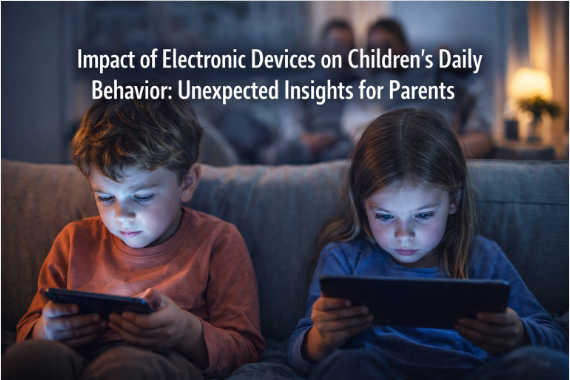
Impact of Electronic Devices on Children’s Daily Behavior: Unexpected Insights for Parents
In many homes, electronic devices are no longer occasional tools. They are part of the rhythm of everyday life. A tablet may help a child eat breakfast quietly, a smartphone may keep them busy during a car ride, and a television may become the background noise of the evening. For parents, this can feel practical, normal, and sometimes necessary. Yet the real impact of electronic devices on children’s daily behavior often appears in subtle ways that are easy to miss at first. It is not always about obvious “too much screen time.” Sometimes it shows up in mood swings, reduced patience, sleep struggles, difficulty focusing, faster boredom, or resistance during device-free moments.
The conversation around children and screen time is often too simple. Parents are usually told to either strictly limit devices or accept that technology is the future. But real family life happens somewhere in the middle. Most children today learn, play, socialize, and relax with digital tools. The deeper question is not whether devices exist in a child’s life. It is how those devices shape behavior, habits, attention, emotions, and relationships across an ordinary day. When parents observe carefully, they often discover unexpected patterns that have less to do with “bad behavior” and more to do with how a child’s nervous system responds to stimulation, reward, interruption, and routine.
One of the most surprising insights is that electronic devices do not only affect the time children spend on screens. They can influence what happens before screen use, during it, and long after it ends. A child who becomes frustrated while getting dressed, distracted during homework, or irritable at dinner may not seem connected to a gaming session or video app from earlier in the day. But behavior does not happen in isolation. Digital experiences can leave a lingering emotional and cognitive effect. Fast-moving content, constant novelty, colorful alerts, and instant rewards can condition children to expect a level of stimulation that ordinary life simply does not provide. As a result, quiet tasks can begin to feel unusually hard.
This is where many parents misread the situation. They may assume a child is becoming lazy, oppositional, or less disciplined. In reality, the child may be adapting to a high-input environment. When a device delivers immediate entertainment, personalized content, quick transitions, and predictable reward cycles, everyday routines such as reading, tidying up, waiting patiently, or even having a normal conversation can feel slow by comparison. This does not mean technology automatically harms children. It means electronic devices and child behavior are closely linked, and the design of digital media can shape expectations in ways families do not always anticipate.
Another unexpected effect is how devices influence emotional regulation. Many children use screens not only for fun but also for comfort. When a child is upset, bored, anxious, or overstimulated, a device can quickly soothe them. In the short term, this may seem helpful. The room becomes calm, the crying stops, and the parent gets relief. But over time, a child may begin to rely on external digital stimulation instead of developing internal coping strategies. That can make it harder for them to manage disappointment, frustration, loneliness, or boredom without a screen. Parents then notice more intense reactions when devices are removed, not because the child is spoiled, but because the device has become part of their emotional regulation system.
This is one reason why smartphone addiction in kids and screen dependency are growing concerns in family conversations. The issue is not always addiction in the clinical sense. More often, it is a strong habitual attachment. Children may reach for a device automatically when there is a pause in the day. They may lose interest in offline activities that once felt enjoyable. They may become restless in moments that require imagination, patience, or self-direction. This shift can change the emotional tone of the household. Parents may feel they are constantly negotiating, reminding, or correcting, while children feel misunderstood because the device has become their preferred way to relax.
Sleep is another area where the impact of electronic devices on children’s daily behavior becomes very visible. Many parents focus on bedtime routines but overlook how screen exposure changes a child’s body and brain in the evening. Bright light, stimulating games, social media, and emotionally intense videos can all make it harder for children to transition into rest. Even if a child appears tired, their brain may remain activated. This can lead to delayed sleep, lighter sleep, difficulty waking up, and irritability the next day. Once sleep quality drops, behavior often shifts rapidly. A child with poor sleep may appear hyperactive, emotional, unfocused, or unusually sensitive. Parents sometimes treat those daytime issues as separate problems, when in fact they may begin with evening device habits.
Attention span is also deeply affected by digital patterns. Many apps, games, and video platforms are built around rapid engagement. Children are exposed to short clips, automatic recommendations, interactive features, and frequent changes in visual and auditory input. Over time, some children become less comfortable with sustained concentration. Homework, reading, problem-solving, and even face-to-face conversation may feel less rewarding than digital interaction. This does not mean devices permanently damage attention, but it does mean screen time and attention span in children are worth monitoring closely. If a child can focus intensely on a game but not on schoolwork, the issue may be less about inability and more about what kind of stimulation their brain has learned to prefer.
Parents are often surprised to notice changes in social behavior as well. Electronic devices can connect children to peers, educational content, and creative opportunities, but they can also reduce the amount of real-world interaction that helps children build empathy, patience, and conversational skill. Social growth often happens in the slow, unedited moments of life: waiting for a turn, reading facial expressions, handling awkward silence, negotiating a disagreement, and staying present without constant entertainment. When devices dominate free time, children may get fewer opportunities to practice these skills naturally. They may become more withdrawn, more reactive, or less comfortable with unstructured family interaction.
One of the most overlooked insights is that device content matters as much as device duration. Not all screen time affects behavior in the same way. A calm educational program, a creative drawing app, a video call with relatives, and a highly stimulating game do not have identical behavioral outcomes. Parents who only count hours may miss the more important question: what kind of digital experience is shaping the child’s mood and habits? Fast-paced, reward-heavy, emotionally intense content often has a stronger carryover effect into the rest of the day. Meanwhile, purposeful and limited digital use may fit into a child’s routine with far less disruption. This is why the best parenting in the digital age is not based only on strict rules. It depends on observation, context, and adjustment.
Family routine plays a major role here. Children respond strongly to patterns. If screens are used during every transition, every meal, every waiting period, or every emotional upset, they stop being occasional tools and become central to the structure of the day. That changes behavior because it changes expectation. A child who always gets a device when bored may struggle to initiate play independently. A child who always watches something while eating may find meals without entertainment frustrating. A child who always ends the day with gaming may resist quieter bedtime rituals. These are not random preferences. They are learned associations, and they shape daily behavior more than many parents realize.
There is also the issue of parental modeling, which is rarely discussed honestly enough. Children do not only react to their own screen habits. They absorb the digital behavior of adults around them. If parents are constantly checking notifications, multitasking during conversation, or splitting attention between family and devices, children may mirror that fragmented style of living. They may speak more loudly to be noticed, interrupt more often, or seek constant stimulation because presence feels inconsistent. In some homes, what looks like a child behavior problem is partly a family attention problem. This insight can be uncomfortable, but it is powerful. Healthy digital habits for families usually begin when adults examine their own relationship with screens.
The good news is that children are highly adaptable. Small changes in screen routines can produce surprisingly meaningful improvements in behavior. Parents often do not need extreme measures. They need consistency. A child who has device-free meals, a calmer evening routine, more outdoor play, and clear boundaries around entertainment often becomes more cooperative, emotionally steady, and engaged over time. The key is not punishment but replacement. If a device is removed without adding connection, movement, rest, or meaningful alternatives, conflict usually increases. But if screen limits are paired with conversation, boredom-friendly activities, hands-on play, reading, family rituals, and predictable expectations, many children adjust better than parents expect.
Another unexpected insight is that boredom can be beneficial. In a highly digital environment, boredom is often treated like a problem to solve immediately. But boredom is also the doorway to creativity, self-direction, and resilience. Children who are constantly rescued from boredom by electronic devices may miss the chance to invent games, think deeply, notice their environment, or build patience. At first, reducing screen stimulation may lead to complaints. That is normal. But after the initial discomfort, many children begin to rediscover forms of play and focus that had been crowded out by constant digital input. This is one of the most hopeful parts of the conversation: behavior can improve when children are allowed to reconnect with slower experiences.
Parents should also remember that behavior is communication. If a child becomes angry when screen time ends, unusually tired after using a tablet, distracted during school tasks, or emotionally flat after long video sessions, that behavior is providing information. Instead of seeing every device-related struggle as disobedience, it helps to ask: what is this habit doing to my child’s energy, expectations, sleep, mood, and attention? That mindset leads to better decisions than guilt or panic. Families do not need fear-based parenting. They need awareness-based parenting.
In practical terms, the most effective approach is usually balanced and specific. Create tech-free spaces where children can rest their minds. Protect sleep by limiting stimulating screen use before bed. Watch for behavior after certain apps or games rather than assuming all content is equal. Build routines where devices are tools, not default companions. Encourage offline play, outdoor movement, reading, and conversation. Most importantly, stay connected. Children are more likely to accept healthy digital boundaries when they feel understood rather than controlled.
The impact of electronic devices on children’s daily behavior is real, but it is not always dramatic or immediate. Often it appears in the small shifts: shorter patience, lower frustration tolerance, more resistance to ordinary routines, less interest in unstructured play, and greater emotional dependence on digital stimulation. These changes can be easy to normalize because technology is so woven into modern life. Still, when parents step back and observe with fresh eyes, they often discover that devices are influencing far more than entertainment. They are shaping the pace, mood, and behavioral patterns of childhood itself.
The goal is not to raise children who fear technology. It is to raise children who can use technology without being ruled by it. That begins with parents noticing the unexpected, responding with intention, and building a home where screens support life instead of dominating it. In the end, the most valuable lesson is simple: children do not just need limits on electronic devices. They need enough sleep, enough connection, enough movement, enough boredom, and enough real-life presence to grow into emotionally healthy, attentive, and balanced human beings.
For stronger SEO on your site, naturally reinforce this topic with search-friendly phrases such as impact of electronic devices on children’s daily behavior, screen time effects on kids, child behavior and technology, electronic devices and child development, smartphone addiction in kids, how screens affect children’s behavior, parenting in the digital age, screen time and attention span in children, sleep problems caused by screens, digital habits for families, emotional effects of screen time on children, healthy screen time rules for kids, tablets and smartphones for children, parental control and digital wellness, reducing screen time for better child behavior, and technology and children’s mental health.