
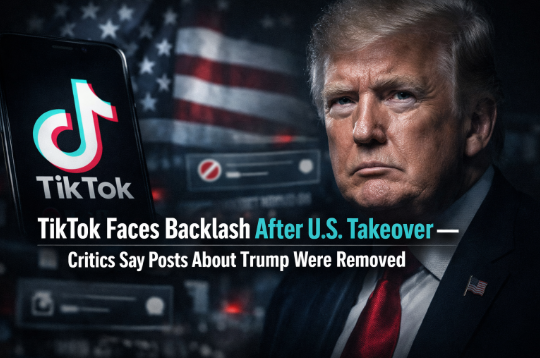
After coming under U.S. ownership, TikTok bans criticism of Trump.
The headline writes itself and then bites back. Today is January 27, 2026, and the social feed that has held a generation’s attention for the better part of a decade is once again at the center of an argument about power, politics, and speech. TikTok has completed its reshuffling into a new U.S.-domiciled joint venture—an arrangement widely described as “majority U.S.-owned”—and within days, accusations erupted that the platform was suppressing or burying videos critical of President Donald Trump. California Governor Gavin Newsom put it bluntly, claiming his office received reports and “confirmed instances” that anti-Trump content wasn’t being surfaced normally. TikTok, for its part, says a data center outage produced cascading bugs and delays—annoying, yes, but not a political muzzle. The truth that matters for users is how a platform behaves, not how it explains itself. For lawmakers and lawyers, intent matters. For creators, reach matters. For democracy, trust matters. And trust is fragile. (Reuters)
Let’s rewind thirty seconds (which is an eternity in TikTok time). The company’s ownership has been an open geopolitical wound since at least 2020, with court cases, executive orders, and congressional hearings spawning acronyms and headlines in equal measure. The Protecting Americans from Foreign Adversary Controlled Applications Act (PAFACA) became law in April 2024 and effectively forced a qualified divestiture by January 19, 2025, unless TikTok wanted to be scrubbed from U.S. app stores and hosting providers. That law—and later, the Supreme Court’s decision upholding it—set the timer. Negotiations extended and deadline dances ensued, but by late 2025 into January 2026, TikTok announced a structure: a U.S.-based joint venture, with American and global investors controlling roughly 80.1% and ByteDance retaining a minority stake just shy of 20%. It’s a technical answer to a political question, and it bought the app its survival. (Wikipedia)
That brings us to the week’s controversy. Newsom’s allegation—suppression of content critical of Trump—did not arrive in a vacuum. In the post-deal afterglow, questions from security experts and policy analysts were already swirling: Who truly controls the algorithm? Who signs off on moderation policy? Who audits the pipes moving data and distributing videos? The new venture leans on Oracle infrastructure and American board oversight, with named investors like Silver Lake and MGX in the mix. Trump publicly praised the restructuring and has repeatedly emphasized how central TikTok was to his 2024 ground game. That context is precisely why accusations of political favoritism hit nerves. If a platform’s new owners are seen as aligned with a sitting president, every moderation quirk becomes a Rorschach test. (Reuters)
Here are the facts as they stand right now. California’s Department of Justice is reviewing the claims. News outlets report that creators experienced slowed uploads, odd behavior in discovery, and glitches that coincided with posts addressing Trump—allegations TikTok attributes to a technical failure linked to a data center power issue. That explanation is plausible; large platforms have complex, failure-prone systems, and an outage can produce symptoms that look arbitrary from the outside. Yet plausible engineering stories don’t erase patterns that creators feel in their bones, especially when timing aligns eerily with politics. The next steps—audits, transparent disclosures, logs, and reproducible tests—are what determine whether the story becomes “buggy weekend” or “platform tilt.” (Reuters)
It’s worth noting the ownership logic that got us here. The United States did not merely demand “more guardrails”; it codified a divest-or-ban approach. That approach culminated in a joint venture that promises “comprehensive data protections, algorithm security, content moderation, and software assurances.” The pitch is that U.S. investors, U.S. servers, and U.S. governance reduce foreign leverage and improve accountability. The counter-argument from civil libertarians is that swapping flags doesn’t magically fix opacity. The algorithm remains a black box either way, and content rules—lawful but awful speech, political misinformation, satire that looks like disinformation—still require human judgment at breakneck scale. A U.S. board can misjudge as easily as a Chinese one. The burden isn’t just to be fair; it’s to be convincingly, demonstrably fair. (Pitchfork)
If you’re a creator, these debates translate into practical anxieties. Does your anti-Trump explainer get stuck in processing purgatory while a cat video rockets to the For You page? Does your civic-minded stitch about protest logistics get flagged as “sensitive” while a dance trend sails through? Under any ownership regime, the incentives are the same: maximize engagement, minimize scandal, and keep regulators at bay. When politics heat up, risk-averse moderation can shade into over-removal. Automated systems trained on vague rules will behave like overly cautious hall monitors. And when the president himself publicly celebrates the new ownership that saved the platform from a ban, critics will naturally wonder whether the hall passes run only one way. (Reuters)
To be clear, the headline making the rounds—“TikTok bans criticism of Trump”—papers over nuance. At this hour, what we have are allegations of suppression and a state-level review, not a published, formal policy that says “no criticism allowed.” That distinction matters in law and journalism. It also matters in search results, where sensational claims can outrun their evidence. Responsible coverage should emphasize the state of play: accusations by a sitting governor, denials by the platform, ongoing investigation. The platform’s promise of a technical root cause analysis is testable. A good report will show when, where, and how the bugs appeared and why some content types were disproportionately affected. If the patterns track to network partitions or queue backlogs, say so. If not, explain the discrepancy. Transparency is a disinfectant and a shield. (Reuters)
For policymakers, this moment is a stress test of the divestiture theory. The 2024 law was sold as a way to de-risk foreign control, not to tilt the field toward domestic political interests. If the very first news cycle after the deal centers on alleged favoritism toward the president most associated with both attacking and later praising TikTok, then oversight bodies must do more than nod solemnly. Auditable transparency mechanisms—externalized logs for content ranking changes around major political moments, independent third-party access to incident telemetry, clearly published error budgets for content delivery—could help. So would a public commitments charter that draws bright lines around political expression, with quarterly enforcement reports and raw data releases for researchers. Platforms often resist this level of disclosure, but if your business touches elections, sunlight isn’t a luxury; it’s part of the social license to operate. (itif.org)
For users, the question is simpler and more personal: Can I trust what I’m seeing? Trust doesn’t require perfection; it requires predictability and clarity. If your anti-Trump video is delayed, you deserve a banner that says “We’re experiencing upload delays due to an outage” with a link to a status page, not a ghostly silence. If your video is removed, you deserve a specific policy citation and an appeals path that gets answered by a human when stakes are high. If your views crater during a political week, you deserve visibility into whether the platform throttled certain hashtags or temporarily adjusted distribution to triage misinformation surges. The day a platform treats creators as partners in resilience rather than liabilities to be managed is the day these controversies lose their sting.
Here’s the paradox: TikTok’s U.S. deal may in fact make robust transparency easier. With a majority-American board, heightened scrutiny, and a fresh political spotlight, the platform has every incentive to over-communicate and invite audit. The investors involved—cloud providers, private-equity shops, and global funds—know that regulatory goodwill is an asset. Voluntary disclosure and independent verification could turn a delicate moment into a reputational win. It’s not enough to say “trust us; it was an outage.” Show your work. Open the books on that incident, publish a retrospective with technical diagrams, list the teams involved, and release the mitigation timeline. If the issue truly was a mechanical failure, the documentation will read like a classic postmortem and the controversy will move on. (Pitchfork)
Meanwhile, critics are right to push. The whole point of a free society is that power must be prodded, audited, and occasionally embarrassed into alignment with its values. Journalists asking tough questions, governors launching reviews, civil society groups demanding logs—this is the immune system doing its job. It doesn’t prove guilt; it proves vigilance. And vigilance is not censorship; it’s how you avoid it.
There’s a bigger cultural undercurrent here. Short-form video platforms are not just entertainment machines; they are memory machines. They decide which frames of our collective life get amplified and which fade into the scroller’s blur. When you shift ownership or governance of such a machine, you change its gravitational pull. Maybe only a little; maybe a lot. Even small changes at the algorithmic core can reshape which voices feel heard and which feel ghosted. In a charged political year, those small changes feel enormous. That’s why this moment feels like more than a technical snafu—it feels like a referendum on whose stories the machine prefers.
So what should happen next? First, let the California inquiry run and insist on a public report with evidence, not vibes. Second, ask TikTok to publish an incident postmortem with traffic graphs, queue metrics, and code-path analysis—ideally reviewed by an independent auditor with read-only access to the relevant logs. Third, push for a standing “election-adjacent transparency bundle” across all major platforms that includes: (a) near-real-time dashboards for policy enforcement on political speech; (b) public archives of downranked topics with justifications; (c) researcher APIs with privacy-preserving access to distribution data; and (d) binding commitments against governmental or owner-aligned meddling in ranking. None of this requires revealing trade secrets; all of it would improve trust.
Finally, creators and users should diversify their communications channels. No platform deserves a monopoly on your audience or your attention. Cross-post, maintain a newsletter, keep a web hub you control, and learn to read platform status pages like a pilot reads instruments. Outages will happen. Moderation mistakes will happen. The work is to ensure that errors don’t map too neatly onto political convenience, and that when they do, we have the tools to tell the difference between coincidence and design.
For anyone tempted to dismiss this as “just another TikTok panic,” remember what’s at stake: a daily public square for hundreds of millions of Americans. When a platform this large sneezes, the culture catches a cold. If the symptoms disproportionately affect one side of a political conversation—whether by bug, bias, or the complicated overlap of both—there’s a public interest in diagnosing it quickly and publicly. The new U.S. ownership was supposed to settle the question of influence. It may instead have sharpened the question of accountability.
The prudent stance today is neither to accept the censorship headline at face value nor to swallow the outage explanation whole. Demand receipts from all sides. Put the data on the table. If the platform can demonstrate a neutral, boring engineering failure, terrific—boring is underrated. If investigators uncover patterns that defy the outage narrative, then the post-deal governance must prove its worth by correcting course in daylight. Either way, the measure of success isn’t which team wins a news cycle; it’s whether creators and citizens can see how decisions are made about the speech that shapes their world. That’s the test of a healthy information ecosystem—and it’s one that no ownership structure can dodge. (Reuters)
Citations & context
— Newsom’s accusation and California review were reported today by Reuters, the Los Angeles Times, CBS, and others; TikTok attributes the incident to a data-center outage causing bugs and delays. (Reuters)
— The new U.S. ownership structure (TikTok USDS Joint Venture, majority U.S.-owned; ByteDance minority stake) and investor lineup were described in multiple outlets and explained as a strategy to avert a U.S. ban and satisfy data-security demands. (Pitchfork)
— The legal backdrop includes PAFACA (April 2024) and subsequent court actions that pushed a qualified divestiture or ban. (Wikipedia)
SEO keyword paragraph: TikTok censorship, TikTok ban 2026, Trump and TikTok, free speech on social media, content moderation transparency, algorithm accountability, California investigation into TikTok, Gavin Newsom TikTok probe, TikTok U.S. ownership deal, ByteDance divestiture, Oracle TikTok partnership, political speech on TikTok, social media regulation 2026, Supreme Court TikTok ruling, Protecting Americans from Foreign Adversary Controlled Applications Act, PAFACA, election misinformation policies, platform governance, digital rights and democracy, creator reach suppression, shadowbanning allegations, data center outage TikTok, content ranking transparency, First Amendment and platforms, tech policy news.