
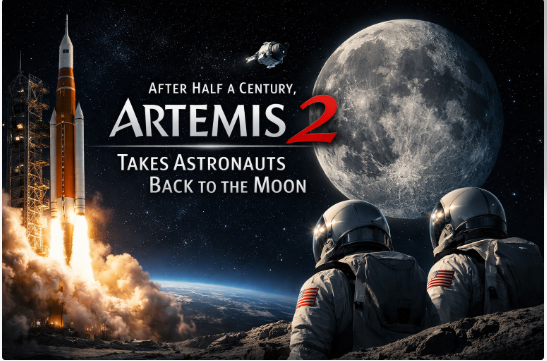
After Half a Century, Artemis 2 Takes Astronauts Back to the Moon
Fifty-plus years after the last Apollo footprints dusted the lunar regolith, the Moon is calling again. Today—February 1, 2026—the countdown is no longer theoretical. NASA’s Artemis II mission stands fueled by a decade of engineering, international partnerships, and the stubborn human itch to see what’s over the horizon. Four astronauts are preparing to strap into Orion atop the Space Launch System (SLS) and swing around the Moon on a ten-day voyage that will take them farther from home than any human has ever traveled. This isn’t nostalgia. It’s a systems test for a sustainable future in deep space, a proving flight designed to shake out hardware, validate life-support, and rehearse the choreography that will eventually put boots on the lunar surface again—and keep them there. As of this morning, NASA lists the launch as no earlier than February 8, 2026, adjusting to Florida’s winter weather and the timing of a critical “wet dress rehearsal” fueling test that must go smoothly before the big day. (NASA)
The crew writing a new chapter
Artemis II isn’t just a spacecraft and a schedule—it’s four people with different backgrounds who together represent where exploration is going next. Commander Reid Wiseman, pilot Victor Glover, mission specialist Christina Koch, and Canadian Space Agency astronaut Jeremy Hansen will form the most diverse crew ever to fly toward the Moon. Koch is set to become the first woman to make the journey; Glover, the first person of color; Hansen, the first non-American to head for deep space. It’s not tokenism. It’s a pragmatic signal: this time, exploration is a team sport, forged by multiple nations and programs that recognize the Moon as a laboratory, a staging area, and a shared frontier. The quartet has moved through integrated tests on the launch tower, capsule ingress drills, and long-duration simulations together, building the trust required for a mission where “nominal” is the most beautiful word in the language. NASA’s health stabilization (quarantine) protocols—recently initiated for the crew—are the last calm before the storm of launch week. (Space)
What “back to the Moon” actually means this time
The phrase can be confusing, so let’s be precise. Artemis II is a crewed lunar flyby, not a landing. Orion will arc around the Moon and return to Earth on a trajectory designed to test deep-space life-support, navigation, communications, radiation monitoring, and the heat shield during a scorching high-speed re-entry. The mission is planned for roughly ten days; at its most distant point it will travel thousands of miles beyond the lunar far side—pushing human presence deeper into space than Apollo ever did. This “distant retrograde” style path doesn’t plant a flag, but it plants confidence. If Orion, SLS, ground systems, and training all perform as expected, the data will reduce risk for Artemis III—the mission that does aim to land astronauts near the Moon’s south pole—once its lander and spacesuits are ready. (NASA)
The hardware stack: SLS and Orion, tuned for deep space
If the Saturn V was the 20th century’s cathedral of power, the SLS is its 21st-century descendant—designed to muscle heavy payloads and crewed spacecraft beyond low Earth orbit. For Artemis II, SLS Block 1 provides the brute force to leave Earth behind, while Orion—NASA’s deep-space crew vehicle—does the precision work of navigation, life-support, and re-entry. On launch day, four RS-25 engines and twin five-segment solid rocket boosters will lift the stack from Pad 39B. After booster separation and an eight-minute core stage burn, Orion will be placed on a high-energy trajectory, execute critical burns using its service module, and settle into the translunar cruise. It’s all heavily automated, but the crew remains the final authority—trained to intervene if instruments and reality start telling different stories. The mission’s “skip re-entry” profile spreads heating loads across two atmospheric dips before splashdown, a key test to validate how Orion handles the brutal physics of coming home from deep space. (Wikipedia)
Why weather and rehearsals matter
Spaceflight is drama with a thousand quiet prerequisites. Before NASA commits people to the sky, teams conduct a “wet dress rehearsal,” loading cryogenic propellants into SLS and running the clock to a simulated T-0. That rehearsal—delayed a bit by unusually cold, windy Florida weather—gives engineers one last chance to flush out leaks, valve behavior, software timing, and ground interface issues. The consequence of a 49-hour campaign like this is schedule ripple: some early February launch windows have been clipped, with “no earlier than February 8” now posted while NASA watches both the weather and the data. The point isn’t speed; it’s certainty. Human spaceflight is where your tolerance for vague outcomes is zero. (The Verge)
From Apollo to Artemis: what’s changed and why it matters
Apollo proved that humans can land on the Moon and return safely. Artemis is about staying power—repeatable missions, polar operations in sunlight and shadow, and a logistics pipeline to support science and technology development. The south polar regions hold water ice locked in permanently shadowed craters, a resource that could be split into hydrogen and oxygen for life support and propellant. Learning to live off-world requires reliable transport, robust habitats, radiation shielding strategies, and surface mobility. Artemis II doesn’t touch regolith, but it’s the dress rehearsal for everything that follows: testing Orion’s environmental control and life support system (ECLSS) with a live crew, checking deep-space comms during high-gain antenna slews, verifying star-tracker performance in the glare of Earth-Moon geometry, and ensuring the heat shield performs as modeled. The first crewed flight must do all of this cleanly so later missions can pile complexity on top—landers, rovers, science packages—without guessing at the fundamentals. (NASA)
The human element: culture, courage, and checklists
Space turns out to be a place where poetry meets procedures. On one hand, there’s the awe of Earth shrinking to a marble and the Moon swelling from a thumbnail to a world. On the other, there’s the relentless cadence of checklists: suit leak checks, comm loops, med kits, contingency abort modes, and “what-if” branches rehearsed until muscle memory takes over. Artemis II’s crew has trained to navigate that duality. They’ll sleep strapped into Orion’s crew module, exercise with compact devices to protect bone density and muscle tone, and manage tight schedules that juggle science, flight-deck operations, media events, and just being human in microgravity—eating, cleaning up, looking out the window, and calling home. The humanized Moonshot of this decade understands that inspiration flows from competence; the most moving moments often come when experts make the hardest things look routine.
Science in the slipstream
While Artemis II is fundamentally an ops test, it carries the seeds of science. Crew-operated cameras and sensors will gather high-resolution imagery of Earth and the Moon, helping refine models of cislunar illumination that future landers will depend on. Biomedical sensors will track radiation exposure and physiological responses over the full arc of translunar flight, building the dataset needed for longer expeditions. Even simple observational logs—how condensation behaves, how glare affects star tracking near the Moon—feed back into designs for navigation and surface operations. Every telemetry packet is a breadcrumb on the path to a lunar base and, eventually, to Mars.
International by design
Artemis isn’t a solo act. Orion’s service module comes from the European Space Agency; Canada, Japan, and many other nations have signed onto the Artemis Accords framework for peaceful, transparent exploration. Hansen’s role on Artemis II is a lived example of that collaboration—an early, visible win for a coalition that wants rules of the road to mature alongside the technology. In a world where low Earth orbit has begun to feel commercially routine, the cislunar neighborhood is still the wild edge. Shared missions, shared standards, and shared data reduce risk and increase political durability—two boring words that quietly determine whether projects survive for decades or fade after a single headline. (TIME)
Safety scars and engineering humility
Artemis II exists because Artemis I did its job in late 2022, flying uncrewed around the Moon and teaching Orion and SLS where their limits are. Engineers then dissected everything—the heat-shield char patterns, avionics behavior, and life-support subsystems—leading to schedule changes and design tweaks. The point of a test program is to learn when it’s cheap, not when people are on board. That philosophy guided the last year of rollouts, stacking milestones, and exhaustive reviews inside the Vehicle Assembly Building and on Pad 39B. The system you see now—on the brink of flight—is the product of that stubborn caution. It’s not flashy. It’s the quiet pride of work that has been checked, cross-checked, and only then declared “go.” (Wikipedia)
What you’ll see on launch day (and why it matters)
When SLS lights, keep an eye on the plume structure from the boosters—a brilliant, roaring curtain that dwarfs everything around it. The core stage’s RS-25s will leave a ragged, incandescent line that curves over the Atlantic. Inside, the crew will feel the mathematics: a steep climb, booster sep with a kick, and the long, hungry burn to orbital insertion. After perigee-raise and system checkouts, Orion’s service module will commit the stack to the Moon with a translunar injection burn. Several days later, the spacecraft will dip behind the Moon, communications will go dark, and—if you like goosebumps—think of that quiet: four people farther from Earth than any human has ever been, with nothing between them and the void but careful engineering and each other. Minutes later, the signal returns, the crew’s voices crackle across the deep space network, and humanity’s confidence in interplanetary travel takes another step from story to schedule. (TIME)
Why this mission resonates far beyond the space crowd
Some see Artemis II as a box-checking exercise. That’s like calling a vaccine trial “just a study.” Carefully run tests are what transform aspiration into capability. A successful Artemis II says a few profound things: that the post-Shuttle United States can build and fly a deep-space system; that international partners can plug into that system as peers; that the next generation will see space not as a cold arena for superpowers but as an expanding neighborhood for science, industry, and yes, wonder. In practical terms, a clean mission unlocks funding momentum, sets production rhythms for hardware, and clarifies timelines for lander readiness and spacesuit delivery. In cultural terms, it reminds us that big, hard, long projects are still possible—and that patience, not hype, is how you bend the arc of technology.
The near-term realities: windows, weather, and watchfulness
As we head into launch week, the watchwords are “data” and “discipline.” The wet dress rehearsal must complete without showstoppers, and meteorology will keep a stubborn veto in its back pocket. NASA’s current posture—“no earlier than February 8”—reflects a sober reading of conditions after cold, windy weather nudged rehearsal timing and early-window options. If the numbers line up, we’ll see a liftoff; if they don’t, NASA will pivot to later February or a backup window. Either way, the mission has already accomplished something rare in a distracted world: it has refocused attention on a goal that outlasts news cycles. And when those four seats are occupied and the sky accepts them, we’ll cross a threshold last passed in 1972—not to repeat history, but to build on it. (The Verge)
How to follow along
NASA will stream the milestones wall-to-wall: crew walk-out, suit-up, hatch close, fueling, terminal countdown, liftoff, orbital insertion, translunar injection, lunar flyby, re-entry, and splashdown. Space watchers will parse every callout; teachers will freeze-frame the trajectory graphics for tomorrow’s lessons; kids will ask brilliant questions adults forgot how to ask. However the exact date shakes out, the message is steady: after half a century, we’re not simply going back—we’re going forward.
SEO Keywords (one paragraph): Artemis 2, Artemis II launch date, NASA Moon mission 2026, crewed lunar flyby, Orion spacecraft, Space Launch System SLS, Reid Wiseman, Victor Glover, Christina Koch, Jeremy Hansen, return to the Moon, NASA live stream, Artemis program timeline, wet dress rehearsal fueling test, Kennedy Space Center Pad 39B, lunar far side flyby, skip reentry heat shield, deep space exploration, Artemis III lunar landing, Moon south pole water ice, international space collaboration, Artemis Accords, European Service Module, spaceflight news today, how to watch Artemis 2, NASA countdown updates, Florida launch weather, human spaceflight history, Apollo vs Artemis, cislunar space, space technology innovations, rocket launch schedule, NASA Orion life support, RS-25 engines, five-segment boosters, translunar injection, splashdown recovery, NASA training quarantine, astronaut crew diversity, science experiments on Artemis 2, lunar mission live coverage, latest space exploration news. (NASA)