
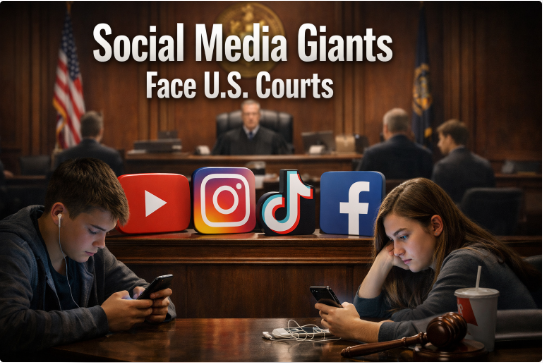
Due to youth addiction… global social media platforms face the U.S. courts.
Every generation discovers a new technology that remakes childhood in ways adults never quite expected. For Gen Z and Gen Alpha, that technology is social media—omnipresent, glowing, and carefully tuned to maximize attention. Over the past few years, the temperature has risen from concern to confrontation, and today the conflict is playing out in U.S. courtrooms. Parents, teachers, pediatricians, and state attorneys general are pressing lawsuits that argue the largest global social media platforms designed addictive features knowing they could harm adolescents’ mental health. The platforms reply that connection and creativity are the point, not compulsion, and that free speech protections and parental responsibility matter, too. Between those positions lies a legal and cultural showdown with implications for product design, privacy, and the future of the open internet.
Why the courts—and why now?
For more than a decade, the conversation about teen social media use sounded like a public-health advisory: limit screen time, model balanced habits, and keep devices out of bedrooms. That guidance still matters. What’s changed is scale and specificity. Families watched doomscrolling migrate from a bad habit to a nightly necessity; school counselors saw anxiety and cyberbullying become ambient rather than episodic; pediatricians flagged sleep disruption, body image distress, and self-harm content. Researchers amassed data on how infinite scroll, autoplay, streaks, push notifications, and algorithmic personalization can nudge vulnerable users to stay longer, click more, and internalize content that intensifies shame or fear. The legal theory taking shape is not “social media exists and kids use it,” but “certain design choices constitute negligent or deceptive practices that foreseeably harm minors.” In other words, the question is not whether teens should use platforms, but whether platforms engineered features that prey on developmental vulnerabilities.
The core allegations: design, duty, and deception
Most complaints share a triad of claims. First, defect by design: elements like endless feeds, variable-ratio rewards (the same psychological pattern used in slot machines), autoplay videos, and social gamification allegedly create feedback loops that are functionally addictive for youth. Second, failure of duty: platforms are said to have prioritized engagement over safety, under-investing in moderation, default protections, and age verification while marketing heavily to younger users. Third, deceptive or unfair practices: critics argue that safety tools are hard to find or easy to bypass, that “age-appropriate” labels don’t match the reality of content exposure, and that public statements downplay known risks. Plaintiffs connect these claims to outcomes: disordered eating, depression, anxiety, attention fragmentation, and, in tragic cases, self-harm. Platforms dispute causality and point to confounders—economy-wide mental-health trends, family environments, and offline stressors. The legal process will need to untangle correlation from causation without trivializing either.
The platforms’ defense: speech, choice, and progress
Defendants typically lean on three pillars. First Amendment arguments say that hosting user speech and recommending content are protected activities, and that courts should be wary of becoming roving censors of algorithms. User choice highlights parental controls, content filters, time limits, and opt-outs—tools, they argue, that enable families to tailor experiences without sweeping restrictions. Continuous improvement emphasizes product changes: default private accounts for younger users, bedtime nudges, fewer notifications at night, sensitive-content screens, and expanded mental-health resources. Companies stress vast investments in trust and safety, third-party partnerships, and transparency reports. They also note a truth sometimes lost in the heat: millions of teens use social platforms to learn languages, discover hobbies, connect with peers, raise funds for causes, or simply laugh. In court, the debate is not whether there is value, but whether the pursuit of engagement has crossed legal lines when the users are minors.
Section 230 enters the chat
You can’t bring a case about social media without tripping over Section 230, the oft-cited law that shields platforms from liability for most user-generated content. Plaintiffs try to sidestep 230 by focusing on product design rather than the substance of posts. The argument goes like this: recommending a post is editorial; designing a reward loop that traps kids for hours is product engineering. If the alleged harm stems from the latter, 230 should not apply. Courts have split on how far that distinction stretches. If design claims survive, they could catalyze a generation of product-safety litigation similar to cases that reshaped autos (seat belts, airbags) and tobacco (warning labels, ad restrictions). If they fail, pressure may migrate to legislatures for statutory reforms. Either way, the precise boundary between “speech” and “software architecture” is becoming the next great internet-law riddle.
What “addiction” means in the youth context
“Addiction” is a loaded word. Clinically, health bodies increasingly use “problematic or compulsive use” to capture the continuum from heavy but manageable engagement to life-disrupting compulsion. For adolescents, the stakes are higher because the brain’s reward systems are in turbo-development while executive control—the ability to resist impulses—matures later. Features such as streaks (daily usage counters), social proof (likes, shares, views), and algorithmic novelty can create intermittent reinforcement that is tricky even for adults to resist, let alone teenagers. Add to this the 24/7 portal of a smartphone and you have a perfect storm. None of this means social media is inherently toxic. It means the risk surface is wide, and that design defaults matter. Courts, which deal in statutory language, will translate those behavioral science dynamics into legal questions: Did a company know the risks? Were safer alternatives available? Were warnings adequate? The answers will set precedent.
Global platforms, U.S. judges
Although the platforms are global, U.S. courts frequently act as both forum and bellwether because many companies are U.S.-based and the U.S. plaintiff bar is uniquely active. But what happens in America rarely stays in America. A win for plaintiffs could ripple into EU Digital Services Act (DSA) enforcement, UK Online Safety Act compliance, and new age-appropriate design codes elsewhere, pushing standardization around data minimization, targeted ads to minors, and algorithmic transparency. Conversely, sweeping defense wins could embolden platforms to harmonize on lighter-touch youth protections and emphasize media-literacy initiatives over product restrictions. International regulators are watching: when one jurisdiction translates concern into binding obligations, others often follow to avoid becoming a dumping ground for riskier product versions.
The product roadmap this pressure is creating
Litigation rarely invents best practices; it accelerates them. Under the combined pressure of lawsuits, research, and policy debates, a likely next wave of youth-safety product changes is emerging:
Age assurance with privacy guardrails. Expect more behind-the-scenes signals (device metadata, usage patterns) combined with privacy-protective checks that don’t require government IDs for every teen.
Time-aware defaults. Harder limits for overnight use, automatic “bedtime modes,” and gradual cooldowns that reduce recommendation intensity late at night.
Sensitive content insulation. Stronger guardrails around self-harm, eating disorders, and sexualized or violent content; easier reporting; more consistent downranking.
Algorithmic transparency windows. User-facing explanations—why am I seeing this?—combined with independent research access through privacy-preserving data sandboxes.
Rewards redesigned. De-emphasizing streaks and public like counts for minors; moving toward pro-social metrics such as completion of creative projects or time spent in educational spaces.
These features won’t satisfy everyone, and each has trade-offs. But they mark a shift from “parental control as optional add-on” to “child-centric defaults baked into the core experience.”
Practical steps for families and schools—today, not someday
While courts argue about statutory interpretation, households and classrooms need tactics that work this week. Three concrete moves have outsized impact. First, device geography: phones charge in the kitchen, not the bedroom; sleep wins. Second, notification surgery: turn off non-essential pings and badges; pull beats push. Third, shared dashboards: use built-in time limits and content filters, but talk about them like coaching, not punishment. Schools can anchor digital-wellness curricula in media literacy (spotting manipulation), self-regulation skills (micro-breaks, breathing resets), and bystander interventions (what to do when a peer spirals online). None of this requires waiting for a judge or a legislature. It reclaims attention as a family resource—scarce, precious, and worth defending.
What a “win” would look like—for everyone
The courtroom drama can make the conflict feel zero-sum: either platforms lose or teens lose. A smarter lens asks what success would look like across the ecosystem. For youth and parents, success means fewer sleepless nights, fewer algorithmic rabbit holes, and more meaningful, creative, or educational interactions online. For platforms, it means clear, workable rules that reward safer design without drowning product teams in contradictory mandates. For educators and clinicians, it means access to data that allows independent evaluation of risks and interventions. And for policymakers, it means laws that are technologically realistic, constitutionally sound, and internationally interoperable. Litigation can’t deliver all of that, but it can raise the cost of unsafe defaults and accelerate alignment around better ones.
The economic subplot nobody should ignore
Engagement is not an abstract virtue; it is a business model. When attention fuels advertising revenue, features that increase session length have an embedded incentive advantage. Any serious reform—whether imposed by courts, regulators, or market pressure—has to reconcile safety with revenue. This is where subscription tiers, contextual ads, and age-based ad policies enter the chat. We may see more “youth modes” with limited data collection and different monetization logic. Platforms that crack the code—serving valuable content to teens while preserving privacy and reducing compulsive loops—will gain reputational and regulatory goodwill that translates into long-term brand equity. In a world of rising acquisition costs and fickle user bases, trust is a growth channel.
The road ahead in 2025: uncertainty, then clarity
Court calendars move slowly—motions, discovery, experts, and appeals can take years. That timeline is frustrating when the issue is urgent, but it also forces rigor. Expect near-term skirmishes over class certification (can plaintiffs represent huge groups of users?), scientific evidence (which studies are admissible?), and preemption (do federal laws block certain claims?). Parallel to the courts, state and federal lawmakers will keep floating bills on age gating, default privacy, and algorithmic accountability. Platforms will continue shipping safety updates, sometimes voluntarily, sometimes after a consent decree. Amid the noise, one signal matters: a cultural pivot from “let kids learn to handle the internet” to “build an internet that handles kids with care.” That shift, once locked in, doesn’t depend on a single verdict. It becomes product doctrine.
Bottom line
“Due to youth addiction… global social media platforms face the U.S. courts” is more than a headline; it’s a diagnosis of a design era. The last decade rewarded frictionless growth and treated attention as an infinite resource. The next decade will be about healthy engagement—the hard engineering of boundaries, context, and recovery. Families will still debate screen time at dinner. Teens will still find ways to outsmart filters. Creators will still invent new formats that land with a dopamine thud. But the center of gravity is shifting toward accountability. Whether judgments land in 2025 or later, the legacy of these cases will be visible in the defaults: what loads by default, what pauses by default, and what gets gently but firmly turned off by default when the user is a 13-year-old at midnight. Courts don’t write code. They can, however, change what good code looks like.
SEO Keywords (one paragraph): youth social media addiction, teen mental health and social media, U.S. lawsuits against social media companies, Section 230 reform, algorithmic transparency, age-appropriate design code, digital well-being for teens, parental controls and screen time, mental health crisis among adolescents, social media harm research, infinite scroll and autoplay risks, notification overload solutions, online safety for minors, TikTok Instagram YouTube Snapchat policies, social media litigation 2025, platform accountability, child privacy online, cyberbullying prevention, content moderation for youth, digital services act compliance, online safety act UK, age verification technology, responsible product design, youth data protection, family media plan tips, school digital wellness programs, ethical algorithms, safer social networking features, adolescent brain and dopamine, subscription vs ad-supported models, healthy engagement metrics, algorithmic recommendation systems, mental health resources for teens, internet law and free speech, engagement-driven business models, screen time limits for children, parental guidance for smartphones, legal risks for tech platforms, online youth safety regulations, best practices for teen social media use.