
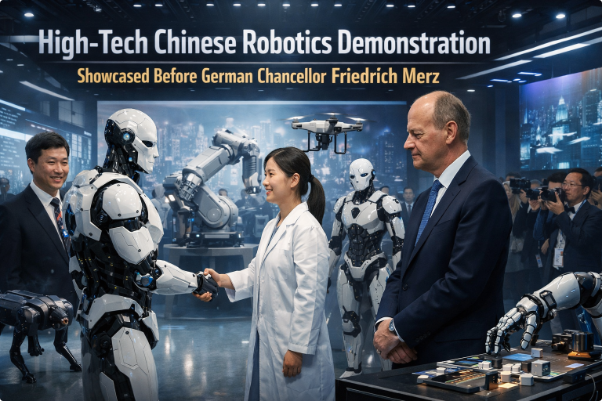
High-Tech Chinese Robotics Demonstration Showcased Before German Chancellor Friedrich Merz
On February 26, 2026, the future didn’t arrive with a polite knock. It walked in, did a backflip, threw a few crisp punches, and then calmly carried a package across the floor like it had a delivery deadline and a point to prove. That was the scene in Hangzhou, Zhejiang Province, where German Chancellor Friedrich Merz visited Unitree Robotics—one of China’s most watched robotics companies—and witnessed a tightly choreographed showcase of humanoid robots, robot dogs, and performance-grade automation that looked equal parts engineering demo and science-fiction trailer. Multiple reports described Merz watching Unitree’s “WuBot” robot martial arts performance and robot fighting demonstrations during his stop in Hangzhou as part of his China trip. (CGTN News)
This wasn’t a “cute tech tour” photo op. It was a strategic snapshot of where AI-powered robotics is heading, and why Germany-China economic cooperation is being tested and reshaped by machines that can move through the physical world with increasing competence. Germany is an industrial heavyweight with deep strengths in advanced manufacturing, automotive engineering, and Industry 4.0. China is accelerating hard into embodied AI—the kind of intelligence that doesn’t just chat about tasks, but does them. Put those together in the same room, and you get the real headline: today’s robotics demonstrations aren’t merely about stunts; they’re about leverage—industrial, economic, and geopolitical.
A Chancellor Walks Into a Robotics Lab…
Merz arrived in Hangzhou to visit Unitree during a trip that Germany’s federal government had already framed as including meetings in Zhejiang and visits to major technology and industrial sites—explicitly naming Unitree among them. (Bundesregierung) That detail matters because it signals intent: this was not an accidental detour, but a planned stop at a company emblematic of China’s push into next-generation robotics.
According to coverage, Merz watched Unitree’s robot performances—especially the martial-arts-themed “WuBot”—and observed product displays including humanoid robots and robot dogs. (CGTN News) Deutsche Welle also reported on Merz’s Hangzhou stop and described the visit as part of the broader China trip, noting Unitree’s founder explaining functions of the humanlike robots. (DW News) Meanwhile Xinhua emphasized the visit as a sign of Germany’s interest in China’s technological innovation, quoting Unitree’s founder/CEO on potential cooperation and the German market. (Xinhua News)
So what did Merz actually see? The demo menu can be read on two levels: spectacle and capability.
“WuBot” and the Power of Spectacle (That Isn’t Just Spectacle)
Let’s talk about robot martial arts for a second—because it’s easy to dismiss it as pure showmanship. But robotics engineers love performance demos for a reason: dynamic movement is brutally hard. Walking is hard. Recovering from a slip is hard. Moving fast without falling is hard. Doing acrobatics while remaining stable is a PhD-level flex.
Reports note that “WuBot” gained visibility via a high-profile performance associated with China’s Spring Festival programming, and then showed up again here, in front of a foreign leader and a business delegation. (Bastille Post) The implication is clear: China isn’t only building robotics capability; it’s building robotics culture—a public-facing narrative that robotics is national competence, not a niche lab curiosity.
In practical terms, a martial arts routine demonstrates multiple foundational robotics competencies at once:
Motion control: precise coordination of joints and actuators under speed.
Balance and stability: real-time correction using sensors and control loops.
Perception and timing: synchronizing sequences reliably (and repeatably).
Mechanical robustness: hardware that can take stress without constant repairs.
It’s not that kung fu is the end goal for industrial automation. It’s that the same control stack that enables a clean kick and landing is adjacent to what you need for a robot that can navigate a factory floor, handle uneven surfaces, or assist in logistics. In robotics, flashy movement is often a proxy for deeper competence.
Robot Fighting, Humanoid Robots, and the “Embodied AI” Arms Race
Coverage described Merz observing robot fights and humanoid robot demonstrations at Unitree. (Global Times) Again, it’s tempting to interpret “robot boxing” as entertainment. But from an engineering lens, controlled physical interaction is one of the hardest frontiers in robotics: contact dynamics, collision prediction, force control, and safe recovery strategies.
This connects directly to the industry’s north star: general-purpose humanoid robots that can operate in human environments—warehouses, hospitals, homes, construction sites—without needing every space redesigned around them. Wheels are efficient, sure, but stairs, door thresholds, clutter, and legacy infrastructure are everywhere. Legs are expensive complexity… until they’re the cheapest way to adapt to the world we already built.
And that’s the big shift: for years, industrial robots dominated because factories are structured, repetitive, and predictable. But the next economic prize is unstructured environments—places where tasks change and the world is messy. That’s where AI robotics becomes less about precision repeatability and more about adaptive competence. The phrase you’ll hear more and more is embodied intelligence (or embodied AI): intelligence that lives in sensors and motors, not just in text.
Robot Dogs, Logistics, and the Quietly Serious Use Cases
Unitree is strongly associated globally with quadruped robots—“robot dogs”—and they’re not just tech mascots. Quadrupeds are particularly useful in environments where wheels struggle: uneven terrain, stairs, rubble, wet surfaces, tight corridors. A demo involving robots cooperating to move packages (described in coverage of Merz’s visit) points toward logistics and warehouse workflows that blend mobility with coordination. (Global Times)
Logistics is where robotics stops being a novelty and starts eating spreadsheets. Why? Because small efficiency gains compound into enormous savings. Faster order picking, fewer workplace injuries, better inventory accuracy, shorter delivery times—this is where smart manufacturing and automation become a national competitiveness story.
Germany knows this better than almost anyone. German industry lives on quality, precision, and supply-chain mastery. But it also faces familiar pressures: labor shortages in certain sectors, the cost of energy transitions, and fierce global competition in manufacturing and automotive markets. When a German Chancellor watches Chinese robotics perform, the subtext is not “cool robots.” It’s: Where does Europe sit in the next productivity wave?
Why This Moment Matters for Germany—and for Europe
Merz’s appearance at Unitree (with a business delegation) is a classic “industrial diplomacy” move: leaders increasingly tour technology champions because manufacturing strength now depends on software, AI, chips, sensors, and robotics supply chains. (Global Times) Germany has been building Industry 4.0 for years, integrating sensors, automation, and data analytics into manufacturing. But the center of gravity is shifting toward systems that can perceive the world and act within it—machines that can do more than repeat a programmed path.
For Germany, the opportunity is obvious: partner, learn, invest, sell, standardize, and co-develop. German firms excel in industrial engineering, safety standards, and high-reliability manufacturing—areas that can complement fast-moving robotics platforms. For China, the opportunity is also obvious: access to Europe’s market, collaboration credibility, and advanced industrial ecosystems.
But there’s also tension. Robotics is not just a commercial product category; it’s a dual-use domain. Many components and capabilities—vision systems, autonomy, mapping, manipulation—have potential military or security applications. That doesn’t mean every robot dog is a weapon, any more than every drone is a missile. It does mean governments will weigh collaboration through a lens of technology security, export controls, and strategic dependencies.
That’s why this visit reads as both a handshake and a stress test: can Germany expand cooperation while maintaining resilience, security, and independence?
The Global Robotics Market: Why Everyone’s Sprinting
Robotics is a compounding technology: each year brings improved actuators, cheaper sensors, better batteries, stronger compute, and more capable AI models. When these curves stack, you get an acceleration that feels sudden to the public—“Wait, robots can do that now?”—but is really the result of a decade of incremental wins.
China has been investing heavily in robotics as part of industrial upgrading, while Germany has long been a robotics power in industrial settings. The new battleground is service robotics, logistics robotics, humanoids, and flexible automation—machines that can shift tasks with minimal reprogramming.
The Merz–Unitree moment crystallizes a broader trend: robotics is becoming as strategically important as semiconductors. Not because robots are magic, but because they turn compute into physical output—moving goods, building things, assisting workers, and reshaping productivity.
What “High-Tech Demonstration” Really Means: The Stack Behind the Show
Even without the engineering schematics on the wall, you can infer the core layers that any modern robotics company must nail:
Hardware: actuators, motors, gearboxes, frames, and power systems that are lightweight but strong.
Sensing: cameras, IMUs (inertial measurement units), joint encoders, force sensors—how the robot knows what’s happening.
Control systems: the fast feedback loops that keep robots stable and responsive.
Autonomy software: mapping, navigation, obstacle avoidance, task planning.
AI perception and learning: recognizing objects, understanding environments, learning behaviors.
Safety and reliability: fault tolerance, emergency stops, compliance with safety standards.
When you see a robot do a stable backflip or box without collapsing into a sad heap of expensive metal, you’re seeing the system’s integration quality. Demos are a narrative, yes—but they’re also diagnostics.
The Business Angle: Why Merz Brought a Delegation
Germany’s government announcement about the trip explicitly referenced the planned visit to Unitree and other industrial sites. (Bundesregierung) That’s a strong tell: this wasn’t just a diplomatic meet-and-greet. It was a commerce-and-capability scouting mission.
German companies are watching robotics for three main reasons:
Factory productivity: robotics and automation reduce downtime and increase throughput.
Workforce support: robots can take over dangerous, repetitive, or ergonomically harmful tasks.
New product ecosystems: robotics platforms can become “operating systems” for physical work, spawning developer ecosystems, service models, and long-tail customization.
In other words, robotics isn’t only a product—it’s an infrastructure layer for the next economy.
The Human Side: Awe, Anxiety, and the Story We Tell Ourselves
Here’s the honest emotional truth: when leaders watch humanoid robots fight and do martial arts, the public reaction splits into two camps—“That’s amazing!” and “That’s unsettling.” Both reactions are rational.
Awe comes from seeing humanlike movement in a machine. Anxiety comes from realizing that physical capability plus AI could disrupt labor markets, reshape security assumptions, and challenge how societies distribute opportunity. A robot that can walk, carry, and manipulate objects is not just a factory tool; it’s a general platform.
The productive way through this is neither denial nor doom. It’s governance, standards, and smart deployment. Germany is well-positioned here because it has strong traditions in industrial safety, regulation, apprenticeship systems, and worker protections. China is moving quickly on deployment and scale. The global “sweet spot” would combine speed with safety—innovation with accountability.
Strategic Takeaways from the Merz–Unitree Moment
By the end of today, the most important thing wasn’t that the robots looked cool (they did). It was what the visit signaled:
Robotics is now diplomacy-grade technology, on the itinerary alongside major industrial players. (Bundesregierung)
China is showcasing embodied AI as national competence, not just laboratory progress. (Global Times)
Germany is actively evaluating collaboration opportunities and competitive positioning in next-gen automation. (Xinhua News)
For readers tracking the robotics market, this is a useful marker on the timeline: February 26, 2026 is one of those dates when the “robotics future” stopped being abstract and became a photogenic, policy-relevant reality.
What Comes Next: Collaboration, Competition, and Standards
Expect the next phase to revolve around less flashy but more decisive battles:
Safety standards for humanoids and mobile robots operating near humans
Supply chain resilience for motors, sensors, batteries, and compute
AI model governance embedded in physical systems
Industrial partnerships between robotics manufacturers and legacy industrial giants
Talent pipelines (controls engineers, ML engineers, mechatronics specialists)
Robotics will not replace everything. It will replace some tasks, reshape many jobs, and create entirely new categories of work. The winners will be the societies and companies that treat robotics as a system: technology + economics + policy + human factors.
And for one afternoon in Hangzhou, that system was on display—performing martial arts, trading punches, and quietly making the case that the 2020s are the decade when AI stopped living only on screens.
SEO keywords paragraph (use as-is): Chinese robotics, Unitree Robotics, German Chancellor Friedrich Merz, robotics demonstration 2026, humanoid robots, robot dogs, AI robotics, embodied AI, robot martial arts WuBot, robot boxing match, Hangzhou Zhejiang, China Germany economic cooperation, Industry 4.0, smart manufacturing, advanced automation, industrial robotics, service robots, warehouse robotics, logistics automation, robotics innovation, robotics partnership, European manufacturing competitiveness, robotics technology trends, artificial intelligence and robotics, next-generation robotics systems, global robotics market, automation strategy Europe, robotics diplomacy.