
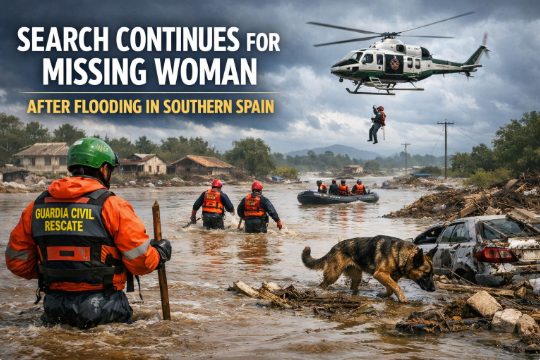
Spain continues searching for a woman missing due to flooding from Storm Leonardo in the south
Before dawn breaks across the saturated plains of southern Spain, rescue teams lace their boots, check their radios, and sweep the riverbanks one more time. What began as heavy rain from Storm Leonardo has turned into a long, nerve-testing search for a woman reported missing in the floods. The storm’s relentless downpours have carved new channels into familiar landscapes, turned roads into rivers, and forced thousands from their homes. And yet the most urgent mission is focused and heartbreakingly simple: find her.
In recent days, the system named Leonardo has trained a firehose of tropical moisture on the Iberian Peninsula, with particular ferocity in Andalucía. Authorities describe swollen rivers that rose with alarming speed, triggering landslides, cutting rail lines, and flooding towns that know seasonal rain but not this—this is different in scale and speed. Meteorologists point to a meandering jet stream and an atmospheric river, a long, airborne conveyor belt of water vapor, as the drivers behind the deluge. Independent tallies and official bulletins agree on the broad picture: thousands evacuated, infrastructure strained, emergency responders stretched thin across several provinces. In one of the most painful threads of the story, a woman in Málaga province was swept away by a surging river during the height of the flooding; the search for her continues today. (The Guardian)
A storm that rewrote the week in the south
Leonardo’s impact has been both dramatic and granular. Streets suddenly carried the force of streams. Culverts and small bridges—old, sturdy, familiar—were outmatched by a volume of water closer to spring snowmelt than winter rain. In coastal towns and whitewashed mountain villages alike, residents watched the water climb up steps, seep beneath doors, and fill garages like bathtubs. The contrast between blue-sky moments and thunderous bursts of rain has been disorienting; people hurried to sweep out one wave of muddy water only to see the clouds darken for the next.
The Agencia Estatal de Meteorología (AEMET) issued red alerts at the storm’s peak and warned that saturated soils had primed the region for flash flooding. In the Guadalquivir River basin, civil protection units monitored gauges as levels rose to danger marks, forcing precautionary evacuations across low-lying zones. Live updates from Spanish press detailed road closures and school suspensions, and local broadcasters kept an hourly drumbeat of advisories for drivers, farmers, and residents living near embankments whose margins narrowed with every new downpour. (elconfidencial.com)
The missing-person search that anchors the response
Against that wider emergency, the search for the missing woman has become a focal point for both officials and neighbors. According to local reports, she was near a swollen waterway when the torrent overcame the banks and pulled her downstream. Crews have deployed ground teams, drones, canine units, and a helicopter during weather windows, working along the river’s curves, checking snags and eddies where debris collects. They’ve asked nearby communities along the flood path to report any sightings of clothing or personal items that might offer a clue. The human psychology of such searches is familiar: the lattice of hope and dread, the way time stretches across the practical rhythms of combing reeds, reviewing footage, and coordinating volunteers. (AP News)
Residents who know these rivers by mood and season have joined professionals at the river’s edge, offering local knowledge—where the current bites hardest after a bend, which groves flood first, how the river behaves after twelve hours of receding flow. That partnership between official capacity and local memory is often the difference between a wide, unfocused sweep and a targeted, efficient operation.
Evacuations, closures, and the knock-on effects
At the height of Leonardo’s passage, authorities in Spain ordered thousands of evacuations in the south as river levels rose and more rain bands approached. Power outages and road closures rippled outward: trucks idled on high ground, delivery routes were recharted on notebooks and phone screens, and small businesses shuttered with handwritten signs that simply read “cerrado por temporal.” Rail lines also felt the strain; landslides onto tracks and erosions near culverts disrupted regional services, with engineers inspecting embankments segment by segment. In Cádiz province, dozens of secondary roads were listed as impassable, complicating everything from ambulance response times to grocery restocking for corner shops that serve as lifelines in scattered hamlets. (elconfidencial.com)
Flood disasters rarely strike just one sector. Agriculture—especially olive groves and citrus—faces both immediate damage (standing water suffocates roots; hillside runoff scars topsoil) and longer-term uncertainties if saturated fields can’t be worked on schedule. After a year when many growers had already been coping with drought-to-deluge whiplash, the timing of Leonardo’s burst adds a grim line to ledgers across Jaén, Málaga (province), and beyond. Economists will do the accounting; for now, families do the mopping, the hauling, the weary arithmetic of drying out.
Why this happened: the science in plain terms
Two features made Leonardo such a prolific rain-maker. First, the jet stream—a high-altitude river of fast-moving air—took a sharp southward sag, guiding storm systems deeper into the subtropics than usual. Second, an atmospheric river tapped moisture from warmer-than-average waters and funneled that vapor toward the Iberian Peninsula. When that ribbon of moisture met the mountainous terrain of Andalusian ranges, the air was forced upward and cooled, wringing out torrents of rain. The setup is like pointing a firehose at a hillside: the flow climbs, slows, and dumps.
Researchers have warned for years that a warmer climate increases the atmosphere’s capacity to hold water vapor—about 7% more per degree Celsius. This doesn’t cause every storm to be extreme, but it loads the dice: when the right synoptic pattern arrives (like this week’s jet-stream kink), storms can rain harder and longer. That line connecting physics to consequences is what communities from Portugal to Morocco have been living through as Leonardo’s bands pinned to the region. Reports from the storm’s passage noted extraordinary multi-day totals that rival a typical year’s rainfall in some microclimates of Andalucía, underscoring how saturation, not just intensity, drives flooding. (The Guardian)
The rescue rhythm: from minutes to days
Search-and-rescue in flood zones follows a tempo dictated by physics, logistics, and luck. In the first hours, responders prioritize swift-water rescues—people trapped in vehicles or surprised by water rising faster than expected. Once those immediate life-safety calls ebb, efforts pivot to door-to-door checks in evacuated zones and targeted searches for the missing. Helicopters scout debris rafts along river curves; drones map flood extents and identify areas where water is receding enough for teams to approach. When rivers finally fall below danger marks, crews can wade or boat into log-choked side channels that might have been too dangerous at peak flow. That’s the window where clues hide.
The Guardia Civil, local firefighters, and volunteer groups have been working in this cadence, grabbing breaks between rain bands and using each dry hour to stretch the search further downstream. Coordination cells match reports from residents with hydrological models that estimate travel times for floating debris. Every new driftwood jam is a place to check twice. (AP News)
Communities stepping up
The heroic image in disasters often centers on a single uniform or a single machine—the firefighter in a raft, the helicopter hovering over a rooftop. The reality here is more decentralized and no less inspiring. Local cafés have been handing out hot coffee to drenched crews. Hardware stores have opened early to replace pumps and hoses that failed under the load. Churches and community centers have put out cots and blankets. And in one coastal town, a mechanic who usually services scooters spent all day coaxing mud-choked generators back to life for elderly neighbors who rely on them to keep medicines chilled or oxygen machines running. The search for a missing person has a way of pulling a region into a single, beating heart; everyone understands what’s at stake because everyone knows someone who walks their dog near a stream or parks under a poplar by the river.
Infrastructure lessons hiding in the mud
When the waters recede, planners and engineers will read the landscape like a report card. Where did floodwaters cross roads that weren’t modeled to flood? Which levees held—and at what cost downstream? Where did culverts clog and send water onto properties that had never flooded before? Answers matter for three reasons:
Future-proofing towns. Housing developments built decades ago around seasonal streams may now sit in places where heavy-rain risk has changed. Updating flood maps isn’t glamorous, but it’s how you spare people the worst surprises.
Designing for failure. Even in a best-case future with rapid mitigation of climate change, rain extremes will still happen. Infrastructure needs graceful failure modes: culverts with debris bypasses, bridges that lose a lane rather than the whole span, pump stations with backup power that can be reached even when access roads go under.
Real-time communication. The most effective alerts during Leonardo were hyper-local: road-by-road, river-by-river. Municipalities that layered text alerts, radio, social media, and old-fashioned loudspeaker vans got the fewest “we didn’t know” reports. That’s not an accident; it’s design.
The broader regional picture
Leonardo didn’t respect borders. While today’s focus is rightly on southern Spain’s search and recovery, Portugal has also faced severe flooding and landslides, with authorities extending emergency measures in dozens of municipalities. To the south across the Strait, Morocco contended with flash floods that displaced families. Extreme weather chains often bead along the same jet-stream thread; one storm preconditions soils, the next tips rivers into crisis. Reports from The Guardian and other outlets framed Leonardo as part of a train of systems funneling across the eastern Atlantic, with another named storm already flagged by forecasters. The scientific and emergency-management communities will be poring over the timeline: where warnings were timely, where they fell short, and how to integrate lessons before the next low spins off the ocean. (The Guardian)
Practical guidance for residents as the search continues
If you’re in a flood-affected area, three simple habits matter most right now:
Treat water as live. Assume every puddle hides debris or a pothole, and every brown floodwater pool may be contaminated. Boots and gloves aren’t fashion; they’re armor for cleanup.
Watch the gauges. Municipal sites and regional hydrology feeds publish river levels that change hour by hour. If a new rain band is forecast and your stream is already near bankfull, make a plan to move vehicles and valuables to higher ground.
Document and breathe. Photograph damage before you start cleaning for insurance and municipal aid claims. Then build yourself five-minute breaks into the job. Disaster fatigue is real; pace beats sprint in the days after a flood.
Emergency lines remain open, and local councils continue to publish road closures and shelter locations. Broadcasters are carrying rolling updates in Spanish and regional outlets are publishing minute-by-minute blogs that collect closure lists, school status, and safety notices. Keep a battery bank charged for phones and a paper map in the glove box; digital navigation can fail when cell towers go down. (OndaCero)
Humanity at the center
It’s easy to turn a storm into a set of statistics. The mind grabs onto numbers because they offer edges to hold. But storms are also made of moments: a mother grabbing schoolbooks off the floor before the water reaches the shelf; a farmer opening a gate to let water find a field rather than a neighbor’s home; a teenager carrying a cat carrier down a muddy staircase lit only by a phone. The missing-person search keeps that human thread taut. Behind every safety briefing is a family waiting for news, a circle of friends swapping updates, a community offering meals and keeping vigil. The teams searching the river aren’t working an abstraction. They’re working for someone.
What comes next
The forecast suggests intermittent relief and lingering hazards: saturated soils, compromised slopes, and rivers sensitive to any new burst of rain. Even as skies open into brighter patches, responders ask residents to treat warning tape as meaningful and closures as real. Drained roads can buckle; apparently solid ground can slump. Official counts of evacuations and closures will evolve as inspectors fan out and as local governments transition from response to recovery. And the search—this painstaking, deeply human search—will continue along the riverbanks until it has an answer. (La Razón)
Verified updates from today (06-02-2026)
Search ongoing for a missing woman in southern Spain after floodwaters from Storm Leonardo; ground, air, and canine units have been deployed in the affected river corridor. (AP News)
Thousands evacuated in Andalucía amid severe flooding, with widespread road closures and continuing disruptions to rail and local services reported by national and regional outlets. (elconfidencial.com)
Exceptional rainfall totals and a saturated landscape linked to an atmospheric river and a southward-shifted jet stream were key to the storm’s intensity over Spain, Portugal, and parts of North Africa. (The Guardian)
Authorities warn of additional systems tracking the same corridor, underscoring the need for ongoing vigilance even as skies intermittently clear. (The Guardian)
Bottom line
Storm Leonardo has tested the resilience of southern Spain’s towns and villages and reminded everyone how quickly water can rewrite the map. As the region cleans, counts, and cares for one another, one promise holds steady: responders and volunteers will keep working the riverbanks, listening for a bark or a rustle of reeds, reading the river like a page. Until there’s clarity, the search is the day’s first priority and its last.
SEO keywords paragraph: Storm Leonardo, Spain floods, Andalucía flooding, missing woman in Málaga, rescue operation Spain, extreme weather Iberian Peninsula, atmospheric river Europe, red alert AEMET, Guadalquivir River levels, road closures Cádiz, evacuations Andalucía today, climate change and floods, search and rescue southern Spain, live updates Spain storm, latest news 06-02-2026, flooding impacts agriculture Jaén, travel disruptions Málaga province, emergency services Guardia Civil, Spain weather alerts today, heavy rain records Grazalema, flash flooding Andalusia, storm damage assessment Spain, public safety advisories Spain, winter storms Europe, Portugal and Spain storm Leonardo.