
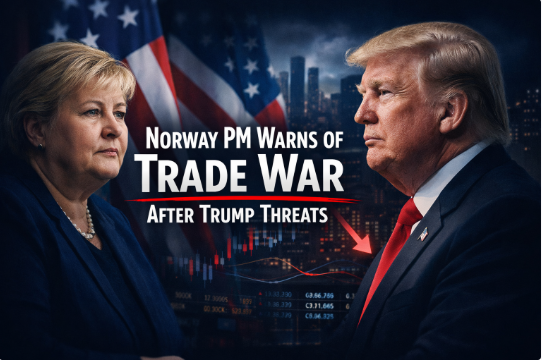
The Prime Minister of Norway warns of a trade war following Trump’s threats.
Let’s be clear about the calendar before we dive in: the developments described here are current as of January 19, 2026 (Asia/Beirut time). On this date, Norway’s prime minister, Jonas Gahr Støre, warned that the transatlantic relationship is inching toward a damaging trade conflict after U.S. President Donald Trump threatened new tariffs on several European allies—Norway included—amid a wider row centered on Greenland. Støre’s message was calm but unmistakable: a tariff tit-for-tat between close partners would be self-defeating, economically costly, and strategically foolish. (The Guardian)
What exactly sparked this? Trump signaled he would slap additional import tariffs—reports commonly describe a 10–25% range—on eight European countries unless they back U.S. aims related to Greenland, which is an autonomous territory within the Kingdom of Denmark. The threat triggered a chorus of pushback across Europe and a joint statement by several allies warning the move risks a “dangerous downward spiral.” Norway threw its weight behind that message, emphasizing that “threats have no place among allies” and that escalating economic pressure would only undercut shared security goals in the Arctic and beyond. (The Guardian)
Støre’s warning sits at the intersection of economics and geopolitics. On the economics front, a new transatlantic tariff fight would reverberate through supply chains that knit together Norwegian energy, maritime services, and advanced manufacturing with European and American buyers. Traders already demonstrated how fast sentiment can sour: global markets wobbled and the dollar briefly lost some altitude as investors tried to price in the risk of a multi-front trade clash and its ripple effects on currencies, defense stocks, and consumer prices. The anxiety wasn’t abstract; it showed up in headlines as investors scanned for knock-on effects in everything from the Danish krone to European equities. (Reuters)
On the geopolitics front, the row lands in the Arctic, a region where Norway has deep expertise and serious stakes—from fisheries and shipping lanes to energy and security. Støre has consistently framed Arctic cooperation as a discipline of patience: you coordinate with allies, you mind environmental limits, and you manage competition with diplomacy to avoid miscalculation. A punitive tariff scheme against NATO partners—over a Danish territory, no less—cuts against that doctrine. The worry is that bludgeoning allies with trade measures to coerce policy concessions will harden positions, invite retaliation, and crowd out the real work of Arctic governance. In other words: short-term leverage, long-term harm. (The Guardian)
European leaders, notably from the UK, France, Germany, the Netherlands, Sweden, Finland, Denmark, and Norway, rallied behind a common line over the weekend: such tariff threats undermine transatlantic relations and could precipitate exactly the kind of economic tailspin that both sides claimed to avoid during earlier trade truces. The EU also dusted off its “anti-coercion instrument,” informally dubbed a “trade bazooka,” signaling it’s prepared to counter unilateral U.S. measures with calibrated European action if push comes to shove. Norwegian diplomats have no interest in firing bazookas of any sort—but they recognize that deterrence sometimes requires visibly sheathing one. (The Guardian)
The Norwegian angle isn’t just about solidarity with Denmark and Greenland. Norway’s economy is unusually exposed to friction at the border. Hydrocarbons, seafood, shipping services, and advanced industrial goods rely on predictable access to markets. Even the rumor of a tariff can chill orders or delay investment decisions. Consider Atlantic cod exports, LNG flows, or maritime equipment bound for North American yards: margins are tight, contracts time-sensitive, and logistics globally entangled. Tariff volatility raises costs and injects a fog of uncertainty into quarterly planning cycles. Støre’s warning recognizes that when the U.S. and Europe trade barbs, exporters from Tromsø to Stavanger absorb the first shock.
Then there’s the security ledger. Norway is a frontline NATO state with a sophisticated view of Russian behavior, a long Arctic coastline, and a habit of pragmatic coalition-building. The government’s assessment is that allied deterrence works best when it’s boring—steady budgets, interoperable kit, consistent exercises, and a lot of quiet coordination. You don’t get that stability if price tags on cross-border components swing wildly because policymakers are brandishing tariff threats as leverage on unrelated territorial issues. The risk isn’t just higher procurement costs for defense; it’s friction in the alliance’s political machinery. If you need to spend a week arguing about cheese tariffs, you have less bandwidth to discuss undersea cables, maritime surveillance, or air policing rotations. Several European statements this week made that precise connection between economic coercion and alliance cohesion. (The Guardian)
Greenland itself is more than a map curiosity. It’s strategically situated between North America and Europe, flanked by sea lanes that—thanks to climate change—are increasingly accessible. It hosts U.S. assets and sits within a wider Arctic theater where Russia and China also have interests. That’s why European leaders found the tariff gambit especially provocative: it tries to convert an alliance conversation about shared security into a zero-sum transaction with an ultimatum attached. From Brussels to Oslo, the counter-message has been simple: support Denmark’s sovereignty, keep the alliance table open, and don’t turn a delicate Arctic balance into a bidding war. (Al Jazeera)
Markets, for their part, did what markets do: they tried to price the chaos. Analysts flagged scenarios in which European currencies wobble, certain defense names catch a bid, and consumer goods face import inflation if the tariff threat hardens into policy. An additional wrinkle is the open question of whether Brussels would retaliate with its own provisional measures, and how quickly. That calculus affects multinational portfolio allocations, hedging strategies for European exporters, and even tourism and aviation sectors if relations sour further. In the worst version of this story, the tariff spiral doesn’t stay in its Greenland box; it metastasizes into unrelated regulatory and standards fights—from data flows to automotive rules—further eroding the transatlantic commercial tissue built since the 1990s. (Reuters)
Against this background, Norway’s messaging has been measured. Officials reiterated that heightened rhetoric won’t solve anything, and warned that escalation benefits nobody—least of all the Arctic stakeholders trying to coordinate fisheries management, search-and-rescue protocols, and environmental monitoring. Notably, Støre echoed a theme heard across European capitals: de-escalate, return to dialogue, and uphold the principle that allies don’t coerce allies with trade weapons. That line—“threats have no place among allies”—is not a throwaway. It’s a doctrine, and it’s gaining signatures. (Anadolu Ajansı)
What happens next? There are three plausible tracks:
De-escalation by design. Back-channel diplomacy, an Arctic-focused working group, and a face-saving communiqué could allow all sides to step back without conceding core claims. Brussels could park the “trade bazooka,” Washington could freeze new tariff actions pending talks, and Oslo could help broker technical discussions on Arctic security that reaffirm Greenland’s status while expanding practical cooperation (climate data, search-and-rescue upgrades, infrastructure resilience). It’s the grown-up option—and historically the one Norway prefers to shepherd. (euronews)
Escalation with guardrails. The U.S. imposes narrower-than-advertised tariffs, perhaps targeted at a subset of goods. The EU responds proportionally under its anti-coercion framework. Both sides keep channels open, but the chill is real: companies delay capex, markets twitch, and the political cost of course correction rises. Norway would spend more capital cushioning exposed sectors and managing alliance fallout. (The Guardian)
Full spiral. Threats harden into broad tariffs, Europe fires its bazooka, and tit-for-tat measures spread into adjacent files (digital policy, standards, aviation, critical minerals). This scenario is why Støre and others are waving bright red flags now. It’s not just bad economics—it’s corrosive to NATO unity at a moment when Arctic and Baltic security demand maximum coordination. The mere credibility of this path is already moving markets. (The Guardian)
There’s also a reputational dimension. Europe remembers the bruises of past trade scuffles, but those skirmishes took place alongside an overarching narrative of shared values and strategic alignment. Weaponizing tariffs against allied democracies—over a partner’s autonomous territory—strains that narrative. Norway’s diplomatic tradecraft aims to preserve a space where allies can disagree vigorously yet still cooperate effectively. It’s the difference between pressure and punishment, between leverage and coercion. Once you normalize coercion among friends, you make it easier for rivals to argue that alliances are transactional, not principled.
Crucially, this week’s European message was coordinated. From London to Berlin, leaders and ministers read from the same hymnal: support Denmark’s sovereignty, keep the alliance intact, and avoid an economic fight that would leave all sides poorer and less secure. Even outlets that rarely sing harmony captured the moment with the same chords—warning of a “dangerous downward spiral” if tariff threats become policy. That phrase is not hyperbole; it’s an attempt to anchor public expectations, markets, and diplomatic bandwidth to the idea that this can—and should—be defused before it crystallizes. (The Guardian)
For Norway, the way forward fuses pragmatism with principle. Expect Oslo to keep emphasizing: 1) Greenland’s status is a matter for the Kingdom of Denmark and its people; 2) Arctic security is best advanced through allied cooperation, not economic coercion; and 3) the transatlantic economy is a shared asset too valuable to be used as a cudgel. The government will also be attuned to real-economy impacts at home—especially for exporters, maritime services, and energy producers. If the U.S. follows through on even a portion of the tariff threat, Norway and EU partners will calibrate a response that protects strategic interests without burning the furniture. That’s not a contradiction; it’s diplomacy.
The bottom line of Støre’s warning is simple enough for any business owner, dockworker, or policy wonk to understand: alliances run on trust and predictability. Tariffs deployed as threats against allies corrode both. The alternative isn’t kumbaya naïveté; it’s a structured negotiation where everyone keeps their powder dry and their spreadsheets open. Europe has the tools to respond, the markets have signaled the cost of failure, and Norway has laid out the stakes. The smartest move for all sides is to step back from the brink, turn down the temperature, and get back to the unglamorous grind of transatlantic problem-solving. That grind has kept the peace, grown prosperity, and stabilized the Arctic for decades. It’s worth protecting. (The Guardian)
Sources and context
European leaders’ joint warnings and Norway’s stance were reported across reputable outlets, including live updates from The Guardian, wire coverage from the Associated Press and Reuters on market reactions, and additional reporting from Euronews, Al Jazeera, and Anadolu Agency capturing Norway’s “threats have no place among allies” message and the EU’s potential “anti-coercion” response. These converge on the same picture: strong allied pushback to tariff threats, a shared desire to avoid an economic spiral, and active contingency planning in Brussels. (The Guardian)
—
SEO keyword paragraph (use as a single, crawlable block):
Prime Minister of Norway warns of a trade war, Norway trade war warning, Trump tariff threats Europe, Greenland tariffs dispute, EU anti-coercion instrument, dangerous downward spiral statement, Jonas Gahr Støre Arctic policy, NATO allies and tariffs, US-EU trade tensions 2026, Norway response to Trump, European joint statement on tariffs, transatlantic relations crisis, market reaction to tariff threats, Reuters AP Guardian coverage, Greenland sovereignty Denmark, Arctic security and trade, Norwegian exports at risk, EU trade bazooka explained, de-escalation diplomacy Norway, SEO news analysis Europe US tariffs.