
The Therian Phenomenon: Adolescents Adopting Animal Identities in Buenos Aires
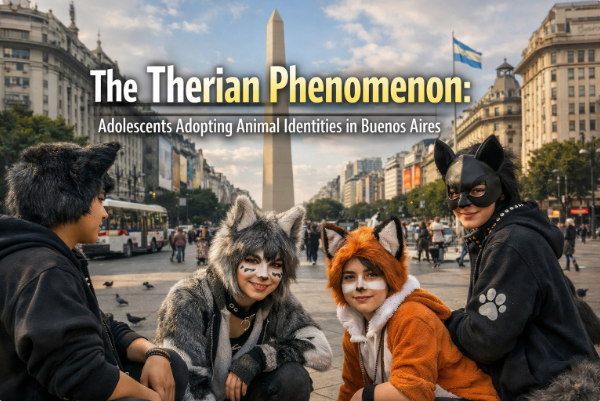
On February 28, 2026, walk through a plaza in Buenos Aires on a warm afternoon and you’ll see the city doing what it always does: mates passed hand to hand, skateboard wheels ticking over cracks in the pavement, teens clustered in bright little constellations of friendship. But look a bit closer—especially around parks, cosplay-friendly meetups, and social-media-organized gatherings—and you may notice something new (or newly visible). A teenager wearing a tail clipped to a belt loop. Another moving with careful, deliberate posture, practicing quadrupedal “animal-style” locomotion. Someone introducing themselves with a chosen name and quietly mentioning they’re a wolf, a cat, a fox—not as a costume, but as an identity.
This is where many conversations begin about the therian phenomenon: adolescents adopting animal identities—often described as therians or part of therianthropy communities—and how this shows up in a real, complex city like Buenos Aires, Argentina. The internet likes to flatten this into a quick punchline or a panic. Real life is messier, more human, and far more interesting. For many teens, identifying as a therian isn’t about pretending to be an animal 24/7. It’s about feeling a deep internal connection to an animal identity—sometimes spiritual, sometimes psychological, sometimes symbolic, sometimes simply personal—and finding language for it in a world that doesn’t always offer many safe, dignified options.
What “Therian” Means (and What It Usually Doesn’t)
A therian typically describes someone who identifies, in some significant way, as non-human—most often as an animal—on an internal level. This can include feeling “animalistic” instincts, a strong emotional resonance with a specific species, or experiences sometimes called “shifts” (changes in mindset, perception, or embodiment). Importantly, therian identity is not the same as cosplay or wearing animal accessories for fashion. It’s also not identical to the furry fandom, which is primarily an interest in anthropomorphic animal art and characters (though there can be overlap).
In Buenos Aires, as in many places, teens might blend aesthetics and identity: ears, tails, paw gloves, makeup, and stylized outfits can become both expression and community signal. But for a lot of adolescents, the point isn’t performance—it’s recognition. Teen years are a developmental storm of identity, belonging, body changes, social pressure, and the aching need to be seen. In that context, animal identity can function like a language for feelings that don’t fit neatly into everyday categories: sensitivity, vigilance, protectiveness, fear, independence, pack-bonding, loyalty, hyperawareness, or even the desire to escape human expectations for a while.
Why Buenos Aires? The Local Texture Matters
Buenos Aires has a special social chemistry for youth subcultures. It’s a city with an energetic public sphere—parks, plazas, cultural centers, student scenes, and neighborhoods where styles collide. Teens can gather in visible spaces and still melt into the urban crowd. Add Argentina’s intense social-media usage, and niche identities can form communities quickly.
It also helps that Buenos Aires has long been friendly to creative self-expression: alternative music scenes, cosplay events, anime conventions, street dance circles, and art collectives provide natural “meeting points” where identity experimentation feels less dangerous than it might elsewhere. For some adolescents, therian identity emerges online first—through TikTok, Instagram, Discord servers, and Spanish-language forums—and then becomes embodied in real-world friendships. The animal identity becomes a bridge: from isolation to a group chat; from a group chat to a meetup; from a meetup to an actual sense of belonging.
The Psychology of Animal Identity: Symbol, Self, and Survival
Let’s be careful and honest here: there is no single explanation that fits everyone. Treating the therian phenomenon as one unified “cause” is like trying to explain all music with one chord. Still, we can explore common psychological themes without turning them into stereotypes.
1) Identity formation in adolescence
Developmentally, adolescence is a prime time for exploring identity. Teens try on roles, aesthetics, values, and labels. Some of those labels are temporary. Some stick. The therian label can be a meaningful identity anchor during a time when everything else feels unstable.
2) Symbolic expression and emotional vocabulary
Animals are powerful symbols. Wolves can represent loyalty and pack bonds; cats can represent autonomy and sensitivity; foxes can represent cleverness and adaptability. Sometimes the animal identity is a symbolic shorthand for temperament. It can be easier to say, “I’m a cat” than to say, “I’m overwhelmed by people, I need boundaries, and I’m afraid of being controlled.”
3) Community and belonging
A teen who feels socially out of sync—neurodivergent teens are sometimes present in these communities, though not always—may find clarity and acceptance in therian spaces. When your peers treat your inner experience seriously, it can feel like oxygen after a long time underwater.
4) Embodiment and control
Some adolescents find animal-like movement (including quadrupedal locomotion) grounding. It can be physical play, stress relief, or a way to feel competent in the body. In a world where teens are often told their bodies are wrong, awkward, or “too much,” physical expression can become a form of self-ownership.
5) Escapism… and that’s not automatically bad
Escapism gets a bad reputation, but it’s also a common human skill. Stories, music, sports, and games are forms of temporary escape that help people cope. For some teens, an animal identity offers psychological distance from social pressure. The key question isn’t “Is it escape?” but “Is it helping or harming daily functioning?”
Online Culture: TikTok, Micro-Communities, and the Algorithm’s Magnifying Glass
The therian phenomenon is deeply shaped by the internet. Platforms reward vivid visuals: tails, masks, “shift” storytelling, and transformation narratives travel well because they’re emotionally compelling and instantly legible. The algorithm can make a niche identity feel huge overnight—especially to a teen already searching for a name for their feelings.
This has two effects at once:
Visibility and validation: Teens learn they’re not alone, find peers, and discover resources.
Acceleration and imitation: Some teens may adopt the label quickly because it’s trending, or because community language provides a ready-made identity script.
Neither outcome is purely good or purely bad. It’s just modern identity formation under a digital microscope. Buenos Aires adds another layer: bilingual or Spanish-first teens may move between English-dominant therian spaces and local Argentine slang, creating a hybrid culture that feels uniquely theirs.
Family Reactions in Argentina: Between Worry, Humor, and Love
Parents and guardians often meet therian identity with a mix of emotions: confusion, fear of bullying, concern about mental health, sometimes laughter, sometimes anger, sometimes quiet acceptance. In Argentina, where family bonds can be intense and intergenerational opinions loud, a teen’s therian identity might become a household debate.
It helps to separate three different issues:
Identity: “My kid says they’re a therian.”
Behavior and safety: “Are they being bullied? Are they meeting strangers? Are they self-harming? Are they safe?”
Mental health: “Is this identity connected to distress, trauma, anxiety, depression, or social isolation?”
A grounded approach doesn’t mock the teen, doesn’t catastrophize, and doesn’t ignore real risks. It treats the identity with basic respect while paying attention to wellbeing. Teens are often testing whether adults can handle truth without turning it into a courtroom trial.
School Life and Social Pressure: The Real Battlefield
For many adolescents, the hardest part isn’t the identity itself—it’s the social environment around it. Schools can be brutal. A tail accessory or animal mask can become an invitation for teasing, filming without consent, or online harassment. Buenos Aires schools vary widely in culture and tolerance, but the general rule is universal: teens are hypersensitive to social status, and difference is sometimes punished.
Supportive educators can help by focusing on:
anti-bullying policies that address online harassment,
creating safe reporting channels,
teaching digital consent (don’t film and post classmates without permission),
fostering clubs or spaces where non-mainstream interests aren’t automatically treated as “disruptions.”
Therian identity doesn’t have to be the center of attention in school to be respected. Often the most effective protection is normalizing basic dignity: you don’t need to “agree” with someone’s identity to treat them like a person.
Therian Identity vs. Mental Health: What’s the Responsible Conversation?
This topic can attract lazy armchair diagnosis. Let’s not do that. Identity labels are not diagnoses. A teen exploring therian identity is not automatically mentally ill. At the same time, any identity can coexist with anxiety, depression, trauma, or loneliness—because teens are humans, and humans come with complicated operating systems.
A responsible, reality-based lens asks:
Is the teen functioning in daily life (school, friendships, sleep, eating, self-care)?
Are they safe (from bullying, exploitation, self-harm)?
Is the identity a source of comfort and community—or a sign they’re retreating from everything?
Are there comorbid stressors (family conflict, grief, abuse, social isolation) that need direct support?
If a teen is in distress, the best move is not attacking the therian identity; it’s addressing distress with compassionate, competent help. Therapy—especially with someone who understands youth culture and identity exploration—can help teens build coping skills without forcing them to abandon self-expression.
The City as Stage: Parks, Meetups, and Micro-Cultures
Buenos Aires has a tradition of public life. That matters. When identity communities can gather in daylight, in parks, near cultural centers, or around events, they gain a kind of social legitimacy. Not official approval—more like the everyday reality of “we exist.”
Some teens will keep their therian identity private, living it mostly as an internal experience. Others will express it through fashion, movement, art, journaling, roleplay, or music playlists that feel like their “species soundtrack.” Sometimes it’s intensely personal. Sometimes it’s social. Often it’s both.
The city’s creative spaces also invite crossover: therian teens might be in anime circles, K-pop dance groups, skate crews, queer youth communities, or art workshops. Identity isn’t a single box—it’s a messy Venn diagram. And honestly, that’s healthier than pretending people are simple.
What Outsiders Get Wrong (and Why It Matters)
Public discourse tends to bounce between ridicule and moral panic. Both are unhelpful. Ridicule makes teens hide and can escalate mental health struggles. Panic can lead to hostile parenting, school punishment, or sensational media stories that harm the very youth they claim to “protect.”
Three common misunderstandings:
“It’s just a trend.” Some cases are trend-adjacent, yes. But even trends can carry real emotional meaning. And some teens maintain this identity for years.
“They think they’re literally an animal in a biological sense.” Most do not. Many describe it as internal identity, spirituality, or symbolism.
“It’s dangerous.” The identity itself is usually not the danger. Bullying, exploitation, isolation, and shame are the dangers.
In other words: the social response can be more harmful than the identity.
A Balanced Take: Curiosity, Boundaries, and Compassion
So how do we talk about the therian phenomenon in Buenos Aires in a way that isn’t shallow? Try this trio:
Curiosity: Ask what the identity means to them—without sarcasm.
Boundaries: Keep safety rules clear (online privacy, meeting strangers, school behavior expectations).
Compassion: Treat the teen’s inner world as real, even if you don’t fully understand it.
When adults respond with calm interest instead of shame, adolescents tend to become more thoughtful and less extreme. Shame fuels secrecy. Respect fuels dialogue. Dialogue is where safety lives.
The Bigger Picture: Humans Have Always Borrowed Animal Language
Therian identity can feel “new” because the internet made it visible, but the underlying impulse is ancient. Humans have always used animals to understand themselves: myths of shapeshifters, spirit animals, heraldry, folklore, religious symbolism, carnival masks, and the basic way we describe personality (“sly as a fox,” “brave as a lion,” “lone wolf,” “social butterfly”).
What’s different now is that teens can form communities around that metaphor—and sometimes treat it as identity rather than just description. That’s a cultural shift. Whether it lasts, evolves, or splinters into new forms, it’s worth studying with humility rather than mockery. Subcultures are like city wildlife: they reveal what’s changing in the ecosystem.
Looking Ahead: What This Could Become in 2026 and Beyond
In 2026, Buenos Aires is watching a familiar story play out in a new costume: young people inventing language for themselves faster than institutions can keep up. Some adolescents will move on from therian identity as they stabilize their sense of self. Others will integrate it into adulthood as a quiet spiritual framework or a creative identity.
The healthier outcomes tend to happen when:
families avoid humiliation tactics,
schools enforce anti-bullying norms,
peers learn consent and empathy,
communities offer belonging without demanding conformity,
mental health support is available when distress shows up.
The therian phenomenon is not a single thing. It’s a collage: identity exploration, symbolic expression, community formation, internet culture, and adolescent psychology—all walking together through Buenos Aires like a pack of mismatched creatures that somehow found each other.
Final SEO Keyword Paragraph (useful for discoverability)
therian phenomenon, therian Buenos Aires, adolescents adopting animal identities, teen identity trends 2026, therian community Argentina, therianthropy explained, what is a therian, youth subcultures in Buenos Aires, Argentine teen culture, animal identity adolescence, therian shifts meaning, quadrobics teenagers, online communities TikTok Argentina, mental health and identity exploration, teen belonging and community, alternative youth culture Buenos Aires, digital youth culture 2026, identity exploration in adolescence, therian vs furry fandom, coping and self-expression teens, bullying prevention schools Argentina, youth psychology Buenos Aires, social media identity trends, nonhuman identity youth, therian safety and wellbeing, Buenos Aires teen subcultures, Argentine youth trends, SEO therian blog keywords