
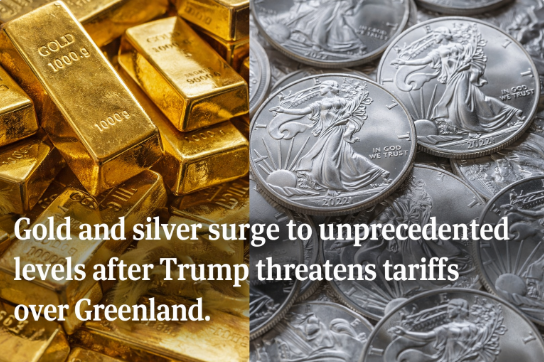
Gold and silver surge to unprecedented levels after Trump threatens tariffs over Greenland
Markets are skittish creatures. Whisper “tariffs” often enough and they bolt for the tall grass; shout “Greenland” on top of that and they don’t just run—they stampede into hard assets. In the latest jolt to a world that already felt like a stack of Jenga blocks on a washing machine spin cycle, gold and silver prices exploded to fresh record highs after President Donald Trump threatened new tariffs on a group of European allies unless Denmark agrees to sell Greenland to the United States. Spot gold punched to an all-time high near $4,689 per ounce and silver spiked to roughly $94, a moon-shot move that had traders refreshing screens like they were watching a rocket launch. (Reuters)
Date note: The record-setting spike and the tariff threat over Greenland are developments of January 17–19, 2026 (not 2025), according to multiple major outlets. If you’re archiving this post, keep that timestamp straight; it matters for the price context and any future back-testing. (Reuters)
What, exactly, set the fuse?
The spark was political, and very specific. In a social post and subsequent comments, Trump said the U.S. would slap an additional 10% tariff on imports from eight European nations—including Denmark, Norway, Sweden, France, Germany, the Netherlands, Finland and the UK—on February 1, with the rate rising to 25% by June, “until a deal is reached” to purchase Greenland. That’s not a sentence most of us expected to read in a macro note, but here we are. (Reuters)
European capitals didn’t shrug. They issued a joint warning about a “dangerous downward spiral,” framing the move as an attack on the transatlantic relationship. The EU convened emergency talks and, according to multiple reports, began sketching countermeasures, including the possibility of tens of billions of euros in retaliatory tariffs. This isn’t just chest-thumping; it’s the kind of policy brinkmanship that reliably pushes capital toward classic “safety” trades. (AP News)
The numbers that made jaws drop
The precious-metals tape told the story in bold font. Spot gold jumped roughly 1.6% intraday, peaking near $4,689; U.S. futures printed similar levels. Silver did what silver does when risk flares—magnified the move—ripping about 4% on the day and tagging a record around $94.08 before easing. Platinum and palladium followed with smaller gains, a reminder that the “flight to safety” often carries the whole metals complex higher, even if gold is the headline act. (Reuters)
These new highs cap an extraordinary twelve-plus months: gold’s surge accelerated through 2025 on the back of relentless central-bank buying, ETF inflows, and a rolling series of trade and growth scares. By April 2025, gold had already vaulted past $3,500; by year-end, analyst houses were publishing roadmaps for further strength into 2026. Today’s geopolitical accelerant simply poured more oxygen on an already hot flame. (IG)
Silver’s performance has been even louder. With heavy industrial demand—from solar manufacturing to high-end electronics and chipmaking—layered on top of safe-haven flows, the white metal outpaced gold throughout 2025 and into early 2026. The gold-to-silver ratio sank toward multi-year lows, a quantitative way of saying “silver sprinted while gold ran.” (Business Insider)
Why the market reacted this way (and why it makes sense)
When tariff talk turns real, investors perform a well-rehearsed ritual: they rotate toward assets that don’t depend on anybody’s promise to pay. Gold in particular has three useful qualities in this kind of drama:
It’s apolitical money. No government can sanction a gold bar; it doesn’t care about customs checkpoints.
It hedges policy error. Trade wars tend to be inflationary in the short run (cost-push dynamics), growth-denting in the medium run, and messy throughout. Gold loves precisely that mix.
It’s liquid when fear peaks. When hedge funds need to raise cash, they sell what’s up—but when retail and institutions move together, they often buy what they understand. Gold is familiar.
Silver rides shotgun but with turbochargers. Its industrial use makes it cyclical in “normal” times; in anxious times, the safe-haven impulse teams up with manufacturing demand, and the charts look like a ski jump flipped upside down. That’s how you get a record above $94 with the headlines we saw this week. (Reuters)
Collateral damage: stocks, currencies, and the atlas of angst
Even with U.S. markets shut for the holiday, the tremor showed up across Europe: indices in Paris and Frankfurt slipped, autos spun out, and tech sagged. Meanwhile, classic refuges—the yen and the Swiss franc—caught a bid alongside bullion. The tape looked like a snapshot from other tariff episodes, just with higher altitude numbers. (The Guardian)
Policy desks in Brussels and national capitals moved fast. Reports indicated the EU was preparing a retaliatory package potentially totaling tens of billions of euros, while diplomats mulled their strongest legal tools under WTO and EU-U.S. frameworks. Headlines like that don’t soothe volatility; they sharpen it. (Financial Times)
The backstory: Greenland, again—and why it hits differently now
If this Greenland déjà vu feels familiar, that’s because it is. The territory’s strategic position—Arctic shipping lanes, critical minerals, and military basing—has been the subject of increasing great-power attention for years. What’s new is the explicit linkage to tariff rates and the naming of specific allies for punishment. That turns an abstract geopolitical tussle into a spreadsheet item for CFOs. It’s the move from narrative risk to cash-flow risk that jolts prices. (AP News)
How traders and long-term investors can process this without losing the plot
First, separate signal from heat. Price spikes on policy headlines carry a lot of emotion. Look beneath the surface at positioning data, ETF flows, and whether today’s close holds above prior resistance. Parabolic intraday highs that fade by the close tell a different story than strong closes on heavy volume. (Today had more of the latter.) (Reuters)
Second, respect silver’s beta but don’t confuse it with a savings account. Silver’s volatility cuts both ways; the same beta that delivered an epic run can shear gains on any de-escalation headline. That’s one reason institutional houses remain more structurally bullish on gold while admiring silver’s sprint—gold’s macro drivers (central bank demand, store-of-value bid) are steadier. (Reuters)
Third, keep an eye on the gold-to-silver ratio. The ratio dropping toward cycle lows is historically associated with late-stage precious-metals booms. It doesn’t mean “top,” but it does mean the easy relative outperformance from silver may be in the rearview unless the industrial bid keeps compounding. (The Economic Times)
Fourth, watch Europe’s retaliation calendar. If the EU rolls out a muscular response—and especially if it targets politically sensitive U.S. exports—the probability tree branches into riskier scenarios. Precious metals could catch another up-draft, but at some point the macro damage bleeds into everything: earnings estimates, capex, and consumer confidence. (Financial Times)
Why “records” don’t mean “the end of the road”
A quick reminder from the dusty library of market history: “record high” is a statistical fact, not a moral judgment. Gold making a new high doesn’t mean it must reverse any more than a toddler standing on a chair means gravity is angry. Prices make records along long, trending paths. In 2025, after clearing psychologically sticky thresholds—$3,000, then $3,500, then $4,000—gold drew in a new wave of participants who had sat out earlier phases. Add a geopolitical accelerant and you get today’s jump. The structural backdrop—central banks diversifying reserves, persistent fiscal deficits, and supply discipline in mining—was already supportive. (IG)
Silver’s structural case is a chimera of two beasts: a monetary metal that rallies with fear and an industrial staple embedded in the energy transition and electronics. That duality is precisely why its chart can look like a polygraph during a job interview. If you’re long, understand what you own. If you’re short, count the exits in case another policy headline turns the dial. (Business Insider)
What would cool the rally?
Three things, none mysterious:
De-escalation with credible timelines. If Washington and European capitals step back from the brink—pausing tariff clocks and opening a negotiation channel that isn’t linked to sovereignty over Greenland—the safety premium can deflate quickly. Watch for joint communiqués that emphasize process over punishment. (AP News)
A hawkish surprise from the Fed. A firmer-than-expected policy stance (or stronger real yields) makes non-yielding assets less attractive. That signal isn’t on deck today, but keep one ear on central-bank rhetoric as the macro calendar rolls forward.
Positioning washouts. If the rally gets too loved too fast, even bullish traders take profits. That doesn’t end a bull market; it resets it.
And what would keep it burning?
EU retaliation that bites. Packages in the €90-plus-billion range would say “game on” and force corporate planners to price sustained friction into 2026 budgets, keeping the safe-haven trade lively. (Financial Times)
Further record headlines. Markets are herd animals; records beget flows, flows beget momentum strategies, and momentum prints fresh records. That’s not philosophy; it’s plumbing. Today’s run was fueled by exactly that loop. (Reuters)
Supply tightness. Miners can’t conjure new ounces on social media timelines. Tight physical markets magnify each wave of fear-driven demand.
The human layer: why this story matters beyond tickers
At street level, tariffs are taxes wearing different hats. They ripple from port to warehouse to checkout counter. If this standoff escalates, your neighbor’s imported car gets pricier, the factory counting on a European component misses delivery windows, and the small business that hedged currency risk but not tariff risk discovers the limits of spreadsheets. Gold and silver rally not because the world ends, but because uncertainty taxes regular life, too. The metals are our old, inert friends when politics vibrate at subwoofer levels.
So yes, cheer if you’ve been long gold and silver through this climb. Also, breathe. Moves like this are reminders to keep diversified, size positions with humility, and remember that volatility doesn’t reward the loudest conviction—it rewards the best risk management. The universe is strange; portfolios should be prepared to live in it.
Bottom line
Fact pattern: Trump’s tariff threat explicitly tied to Greenland jolted markets; Europe signaled unified opposition and sketched retaliation. (Reuters)
Market result: Gold and silver ripped to record highs—gold around $4,689, silver near $94.08—as investors reached for safe havens. (Reuters)
What’s next: Watch the EU policy calendar, any U.S. de-escalation, and flows in metals ETFs. Remember: records are waypoints, not destinations.
SEO keywords (single paragraph): gold price record, silver price record, Trump Greenland tariffs, EU retaliation tariffs, precious metals rally, safe haven assets, spot gold $4,689, silver $94, gold vs silver, gold-to-silver ratio, central bank gold buying, ETF inflows gold, silver industrial demand, solar panel silver demand, geopolitical risk hedging, market volatility 2026, European stocks fall on tariffs, dollar and yen safe haven, commodities news today, investing during trade wars, how tariffs affect markets, gold forecast 2026, silver forecast 2026, best safe haven assets, buy gold online, buy silver online, precious metals investing guide, inflation hedge assets, bullion market update, gold price live news.