
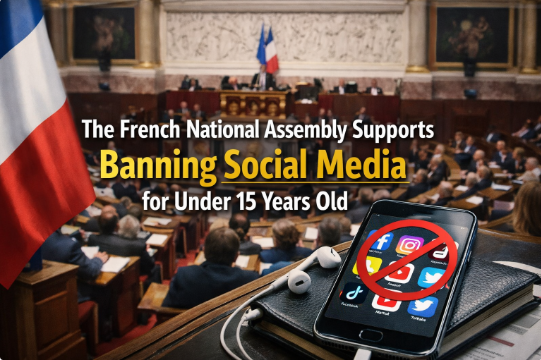
The French National Assembly supports banning social media for those under 15 years old
France has taken a decisive step in the global debate over children, screens, and safety. On 27 January 2026, the French National Assembly approved a bill that would ban social media for children under the age of 15, a move championed by President Emmanuel Macron and backed by a cross-party coalition concerned about mental health, bullying, and algorithmic harms. The measure, which must still complete the legislative process, positions France among the most assertive democracies attempting to redraw the digital childhood. (Reuters)
What exactly did lawmakers vote for?
The lower house endorsed legislation that prohibits social media platforms from allowing users under 15, strengthening France’s approach beyond prior parental-consent rules. Reports from major outlets confirm the bill’s central aim: to make under-15 social media use illegal in France, shifting legal responsibility onto platforms to implement robust age checks. Crucially, the text now moves to the Senate for further examination before any final enactment—so while the political signal is strong, the process is not yet finished. (Reuters)
French coverage has also clarified the vote and calendar. The Assembly’s approval reportedly came by 130 votes to 21, reflecting significant, if not unanimous, support. As for timing, the government wants rapid implementation: a rollout by the start of the 2026 school year for new accounts, with effective age verification for all users (including existing accounts) by 1 January 2027. These milestones will matter both for parents planning the next academic year and for platforms preparing technical compliance. (Le Monde.fr)
Why this now? The political and social backdrop
The push follows years of mounting evidence and public anxiety over the relationship between heavy social media use and youth well-being—issues like cyberbullying, sleep disruption, body-image pressures, and compulsive scrolling reinforced by engagement-maximizing algorithms. Macron and his allies have framed the initiative as a child-protection imperative. After the vote, the president used striking language to argue that children’s brains “are not for sale,” signaling France’s willingness to confront both American and Chinese platforms on their home turf: the attention economy. (ITVX)
There’s also an EU angle. France previously attempted to restrict under-15 access in 2023 by emphasizing parental consent, but that law never entered into force due to friction with the EU’s Digital Services Act (DSA) compliance framework. The current measure reflects lessons from that episode and aligns more closely with Brussels-level obligations, suggesting a more durable pathway to implementation this time. (euronews)
How would platforms verify age?
The political success of an under-15 ban hinges on age verification—the practical, often messy front line. Lawmakers want mechanisms that meaningfully deter underage access without forcing families to surrender excessive personal data. While the bill sets ambitious deadlines and obligations, specifics will likely be spelled out in decrees and guidance developed with France’s data-protection authority and relevant ministries. French reporting stresses that effective age verification for all users must be in place by 1 January 2027, implying a phased rollout and technical consultation period during 2026. Expect a blend of privacy-preserving age checks (e.g., third-party attestations, device-level signals, or cryptographic proofs) and stricter platform enforcement against obvious evasion. (Stratégies)
Parents should anticipate more prompts, stricter onboarding flows, and clearer identity checks for teen accounts. Platforms that already rely on self-declaration (“What’s your birthday?”) will need to upgrade quickly. Enforcement will also intersect with app stores, mobile carriers, and schools, given that the measure sits alongside a broader school phone ban policy expansion into high schools—tightening the environment where under-15s typically access social apps. (Reuters)
Where France fits globally
France’s action follows a notable wave of policy experimentation. Australia moved first with a nationwide under-16 restriction, offering a template Paris has cited explicitly. Other countries, including the UK and Spain, are debating stricter underage rules and age-assurance standards, while U.S. states have pursued varied (and litigated) youth safety laws. France’s step is thus both a local response to domestic public opinion and part of a broader international trend toward codifying a “digital age of majority.” (Reuters)
For Brussels watchers, the measure will test how national child-safety laws mesh with EU-wide rules like the DSA. If France can show credible, privacy-respecting age checks at scale, it could become a reference model for other member states and for the European Commission’s ongoing youth-safety agenda. (euronews)
The evidence lawmakers are relying on
French and international studies have repeatedly linked heavy social media use to mental-health risks, particularly around anxiety, depression, body image, and attention. Lawmakers also cite youth exposure to self-harm content and dangerous challenges. French reporting highlights high smartphone penetration and frequent social networking among 12–17-year-olds, helping explain the urgency underlying the bill. While researchers debate causation versus correlation, the political consensus is that modern platforms can be developmentally inappropriate for younger teens absent strict guardrails. (AP News)
Notably, the Assembly’s move dovetails with public opinion in France, where surveys have shown strong parental support for robust protections. Policymakers are also responding to a series of tragic cases and litigation alleging that unsafe platform design contributed to harm. As with seatbelts or age limits on alcohol, supporters argue that a clear legal rule simplifies the message and improves compliance. (AP News)
Supporters’ case: clarity, calm, and childhood
Backers of the bill argue that age 15 is a meaningful developmental marker. They say a bright-line rule helps families and schools, reduces conflict at home, and protects younger teens from algorithmic rabbit holes. By default, they contend, 12- to 14-year-olds should be learning, sleeping, socializing offline, and developing attention span—without the constant pull of likes, virality, and 24/7 comparisons. Macron and allied lawmakers have framed the measure as protecting “dreams” from algorithms while France still encourages digital literacy and open web use for study and creativity. (ITVX)
In addition, integrating the ban with existing school phone restrictions aims to create a coherent environment: less friction for educators, fewer distractions in class, and a clearer line between study time and screen time. Proponents say the DSA and French law together can incentivize platforms to design safer default experiences for European teens. (Reuters)
Critics’ concerns: rights, realism, and workarounds
Civil-liberties advocates, some opposition lawmakers, and digital-rights groups warn of overbreadth. They argue that an outright ban risks limiting access to legitimate expression, community, and support networks—especially for vulnerable teens who rely on online spaces. They also point to practical evasion: tech-savvy kids can borrow accounts, lie about age, or use VPNs. Critics worry that making billions of age checks enforceable could pressure families to share identity documents or biometrics, raising privacy risks that outweigh benefits. (AP News)
Another friction point is enforcement equity. Families with more digital literacy or time may navigate the new regime more easily, while others could face confusion or inconsistent platform responses. Lawmakers will need to pair the ban with clear guidance, funded digital-education programs, and support for parents and schools, so compliance doesn’t become a postcode lottery. The Senate’s review stage is an opportunity to refine safeguards, exemptions for educational/health platforms, and complaint mechanisms for erroneous age-verification blocks. (Reuters)
What happens next?
Procedurally, the bill proceeds to the Senate. If the upper house amends the text, a reconciliation step could follow before final adoption. The government’s target schedule—September 2026 for new accounts and 1 January 2027 for universal age verification—will push agencies and platforms to agree on technical standards quickly. Expect rulemaking, pilots, and close coordination with the CNIL (France’s data-protection regulator) to ensure that age checks meet EU privacy norms. Parents should keep an eye on official guidance from the Ministry of Education and the digital affairs ministry throughout 2026. (Stratégies)
For platforms, the to-do list is extensive: audit existing user bases for underage accounts, deploy or integrate third-party verification providers, redesign onboarding and reporting tools, train moderators, and proof their systems against obvious circumvention. Because the DSA already imposes obligations for risk mitigation and transparency, companies that act early can align their compliance workstreams and reduce friction across EU markets. (euronews)
Practical tips for families and schools (if the bill becomes law)
Plan for transitions. If your child is under 15 and currently on social media, discuss upcoming changes now. The school-year rollout in September 2026 suggests families will have several months to prepare. Many platforms will likely offer export tools for photos and messages and provide appeals for mistaken age flags. (Stratégies)
Lean on alternative tools. Messaging apps and collaborative platforms used for schoolwork may remain accessible under educational exemptions. Watch for official lists and guidance to avoid accidental violations while maintaining contact with classmates and activities. (AP News)
Use the moment to reset habits. Whether or not a child is nearing 15, consider family-wide sleep-friendly phone rules, no-screen mealtimes, and shared charging stations. Schools can extend device-free zones and align homework expectations with minimized screen time. These changes are easier when the legal environment sets a uniform baseline. (Reuters)
What this means for the tech industry
France’s move accelerates a shift already underway: age-assurance moving from soft policy to hard compliance. Vendors offering privacy-preserving age checks—document scanning with on-device processing, AI-assisted facial age estimation with strict deletion windows, cryptographic proofs from carriers or banks—will see strong demand. The winning solutions will emphasize data minimization and auditability. Platforms that deliver seamless, privacy-respecting flows could turn compliance into a trust advantage with families and schools.
In parallel, content and product teams will re-evaluate youth-specific experiences, possibly carving out under-16 modes with reduced recommendations, elevated moderation, and limited messaging. Even if those features target 15–16-year-olds, some design changes may trickle up to older teen cohorts in France and, soon, across the EU.
The bottom line
The National Assembly’s vote marks a turning point in Europe’s approach to digital childhood. France is signaling that under-15s should not be on social media—full stop—and that the burden falls on platforms to make this real without compromising privacy. The path forward runs through the Senate, standards-setting, and a busy year of technical work. But the direction is unmistakable: childhood online is about to be governed by a clearer, stricter rulebook in France. (Reuters)
Sources and key confirmations
Assembly approval and legislative intent; Senate next steps: Reuters and Al Jazeera. (Reuters)
Implementation timeline and age-verification deadlines: French trade/tech press citing government targets. (Stratégies)
Vote count reported in French media (130–21): Le Monde. (Le Monde.fr)
Macron’s rationale and post-vote statement; school-phone policy link: ITV reporting. (ITVX)
EU/DSA context and the 2023 parental-consent law that stalled: Euronews. (euronews)
SEO keywords (single paragraph): France social media ban under 15, French National Assembly vote 27 January 2026, Emmanuel Macron children online safety, age verification France social platforms, Digital Services Act youth protection, social media mental health risks teens, cyberbullying prevention France, phone ban French high schools, France Senate social media bill, European child online safety rules, underage social media access France, algorithmic harms teenagers, privacy-preserving age checks, TikTok Instagram Snapchat age limits France, social media regulation Europe, parental guidance screen time, digital wellbeing adolescents, French law ban social networks minors, online safety compliance EU, social media policy news today France.